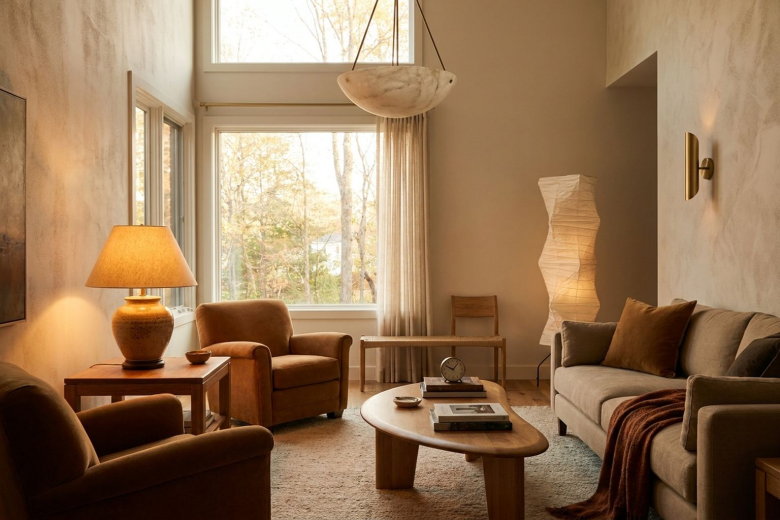
The defining 2027 lighting trends are sculptural, layered and warm. Expect fixtures that work like jewelry, vintage ceramic lamps, paper and alabaster shades, textured glass, oversized pendants, grouped fittings, cordless wall sconces and low, glowing light that replaces the flat grid of recessed cans. The common thread: lighting chosen for feeling first and function second, so rooms feel inviting at 9 p.m., not just bright at noon.

If the last few years were about a grid of bright recessed lights, 2027 is about glow. Homes & Gardens says this year’s trending lighting styles and shapes “are centered around feeling as well as practicalities.” Livingetc writes that “the trends this year focus less on technique and more on feeling,” connecting the mood to “the inescapable surge in all things AI.”
This guide pulls those forecasts into one practical playbook. For every trend you will find what it is, why it is happening, how to do it in a real home, what it costs in effort, and the mistakes to avoid. At the end you will find a styling checklist, a budget guide and an FAQ.
The Big Picture: Why Lighting Is Changing in 2027
Three forces explain almost every trend below.
1. Lighting is now treated as décor. Designers Ushi Schick and Zoe Pinska of Sidemark Studio told Homes & Gardens: “We are seeing a shift toward lighting that feels more like a piece of art than simply a functional fixture.” Alissa Johnson put it more briefly: “lighting is the jewelry of a space.”
2. A craving for softer, warmer light. Livingetc’s September 2026 reporting says low-light rooms are “the vibe for this autumn.” Luke Thomas of John Cullen Lighting warns that “too much light from above can flatten a room, create harsh shadows and remove the sense of depth that makes an interior feel inviting.”
3. Search behavior is moving toward lamps you can place anywhere. In Google Trends data for US searches, related US searches for “ceramic table lamp” were rising by 450%, “mini lamp” by 400%, and “cordless lamp” and “rechargeable lamp” by 250% each. Houzz’s May 2026 US report adds that “low-voltage lighting” searches rose 162% in the first quarter of 2026 compared with a year earlier.
Keep those three ideas in mind. When you are deciding whether a trend suits you, ask: does it make the room warmer, more personal, or more comfortable at night? If it does none of those, skip it. Note that not every trend is growing: Google Trends shows “paper lamp” searches flat and “picture light” up only 6%, so those items rest on designer commentary rather than search momentum.
Sculptural Fixtures That Work Like Jewelry
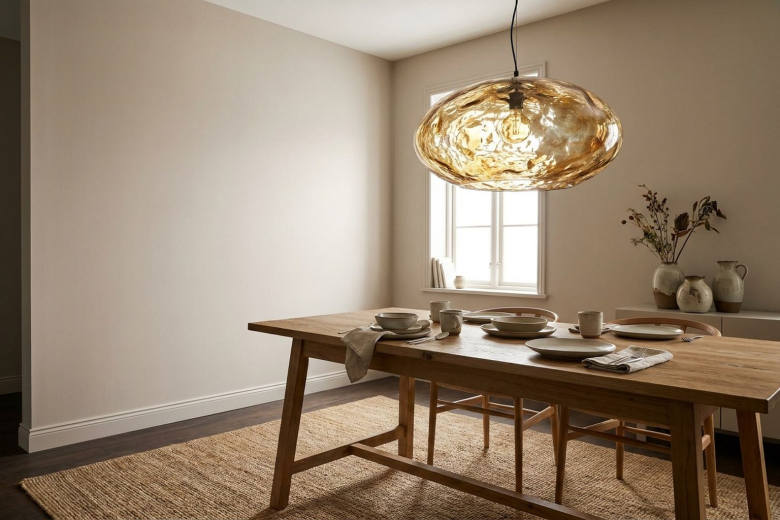

Lamps and pendants designed to look like art even when they are off. Schick and Pinska say that “hand-blown and textured glass, alabaster, ceramic, and beautifully patinated metals bring depth and character to a space, even when the lights are turned off.” Designer Jeffrey Bruce Baker told Southern Living: “I believe lighting is jewelry, so have fun and do not be shy about adorning your space with a dynamic statement.”
Why it works: Murude Katipoglu told Livingetc she loves how plaster, alabaster, glass and metal “interact with light, creating pieces that are as beautiful when switched off as they are illuminated.” A fixture that works as art lets you change the mood of a room without moving furniture.
- Choose one hero per room. A single statement fixture is stronger than three competing ones.
- Keep the surroundings restrained. Katipoglu suggests pairing it with a more restrained material palette so the craftsmanship can shine.
- Pick a material with depth. Hand-blown glass, plaster and ceramic all look good unlit.
- Think about scale and sightlines. View the fixture from the sofa, the table and the doorway before you buy.
- Light it softly. A dimmer lets the fixture glow instead of glare.
Budget options: Livingetc lists an H&M pendant light at £169, a fraction of designer prices.
Mistakes to avoid: Mixing several statement fixtures in one open-plan space. Finch Home Studio warns against it.
Layered Lighting at Different Heights

The end of the single overhead light: ambient, task and accent light at different heights. Trish Lynn of Colette Interiors told Homes & Gardens: “I think we’ll see even more emphasis on layered, atmospheric lighting rather than rooms filled with recessed lights.” She suggests you “start with the architecture and layer lighting at different heights… perhaps sconces around a fireplace, picture lights over millwork, a floor lamp beside a reading chair, and a few table lamps throughout.”
Why it works: Gabriela Eisenhart told Southern Living: “Gone are the days of relying on a grid of recessed lights,” and on color temperature, “you don’t want your home to feel like the grocery store.” Amy Peltier says a living room needs “at least two” lamps, and “four, five, or even six lamps can work beautifully! The goal isn’t to hit a specific number. It’s to create little pockets of warm, inviting light.”
- Start with a count. Shannon Hubby recommends a minimum of one table lamp and one floor lamp.
- Aim for pockets of light. Each seat should have its own source.
- Use lamps first. They are the cheapest layer and need no electrician.
- Add accent light. Sconces and picture lights highlight architecture.
- Switch it all to dimmers. The same room can be lively or calm.
Budget options: Lamps are the least expensive layer to add, and thrifted lamps with new shades work well.
Mistakes to avoid: Forgetting reading light. Bruce Weil of Lighting Design Studio notes, “We have all been in restaurants where the atmosphere looks great, but you need your phone torch to read the menu.”
Vintage and Collected Lamps
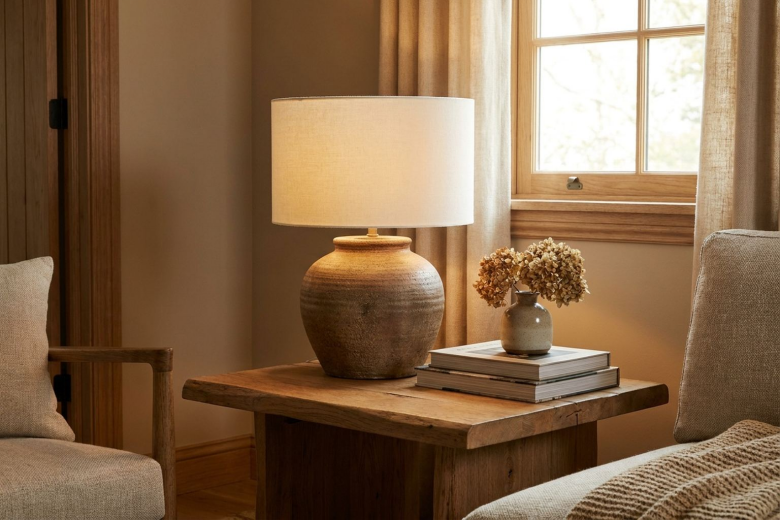
Chunky 1970s ceramics and restored antiques instead of a matching pair from a catalogue. John Maloney McNamara of Coosa told Homes & Gardens that vintage ceramic table lamps “will be everywhere in 2027. The chunky, oversized, earthy ones from the 1970s. Have one rewired, give it a new shade, and you have something that looks collected rather than like the same table lamp everyone else bought.”
Why it works: Designer Samantha Tosti told Southern Living that “nothing tells a home’s story better than the hunt for the perfect item, found at the back of that antique shop downtown.” Google Trends shows “ceramic table lamp” among the rising queries, up 450%.
- Shop estate sales and vintage dealers. McNamara suggests looking there before you buy new.
- Rewire it. Tosti warns it may take searching to find a professional who can rewire the fixture and bring it up to code.
- Give it a new shade. A linen or paper shade modernizes a vintage base.
- Group by material. Pair a ceramic lamp with ceramic vases for a calm look.
- Mix with new. One vintage lamp beside a contemporary pendant looks collected.
Budget options: The budget route is thrift or estate-sale lamps plus a rewire.
Mistakes to avoid: Skipping the rewire or code compliance.
Paper and Washi Lamps

Paper lanterns and parchment shades, from Noguchi’s Akari to affordable high-street versions. Erica Vassalotti of Bergman Vass told Homes & Gardens: “A ‘timeless’ trend in lighting that I think will continue well into 2027 is parchment lighting… Being semi-translucent, parchment reflects light in a stunning way.”
Why it works: Livingetc’s Iokasti Sotirakopoulou notes that Isamu Noguchi began developing his Akari Light Sculptures after visiting Gifu in Japan in 1951, and says “paper gives harder, shinier materials a softness they often need.” Her styling trick: “Hang an oversized paper pendant above a lacquered dining table, place one beside chrome or polished steel, or use a sculptural floor version against dark timber and heavily veined stone.”
- Use paper to soften hard materials. Pair with lacquer, chrome or stone.
- Go oversized. A large pendant has presence for little money.
- Try a floor version. Against dark timber it glows.
- Mind the style match. Sotirakopoulou wouldn’t automatically send a paper lamp into a quiet, all-neutral Japandi scheme.
- Keep it away from heat. Use LED bulbs inside paper shades (writer’s tip).
Budget options: Livingetc’s September 2026 listings show a huge spread: a Dunelm paper lantern pendant shade at £5, an IKEA Vindkraft table lamp at £19, an H&M rice paper table lamp at £34.99, Heal’s Akari 10a floor lamp at £780 and a Vitra Akari 14a floor lamp at £1,010.
Mistakes to avoid: Putting paper into a scheme that is already all-neutral and quiet, where it adds nothing.
Alabaster, Travertine and Stone

Alabaster, travertine and marble in wall lights, pendants and lamps. Finch Home Studio says alabaster, travertine, marble, bronze and aged brass “are appearing in wall lights and pendants.” Houzz’s fall 2026 report says natural stone “is showing up in unexpected applications, including sinks, furniture and lighting,” and Decorilla notes that alabaster diffuses light through mineral veining.
Why it works: Stone gives a fixture weight and a glow that plastic and metal cannot match. Google Trends shows “alabaster lamp” 12-week average searches up about 57% year on year.
- Match the room’s palette. Finch says travertine lighting works especially well with warm woods, plaster, cream walls and bronze or brass accents.
- Use it where it can be seen. A sconce beside a bed or a lamp on a console.
- Pair with plaster walls. The texture reads as one family.
- Check the weight. Stone lamps are heavy; mount sconces properly.
- Buy the stone, not the shape. Finch warns specific sculptural forms may follow a two- to three-year fashion cycle, while the stone itself is more timeless.
Budget options: H&G’s lamp roundup lists a CB2 raw marble table lamp at $158.
Mistakes to avoid: Chasing a trendy form in stone when a simpler shape would last longer.
Oversized Fittings
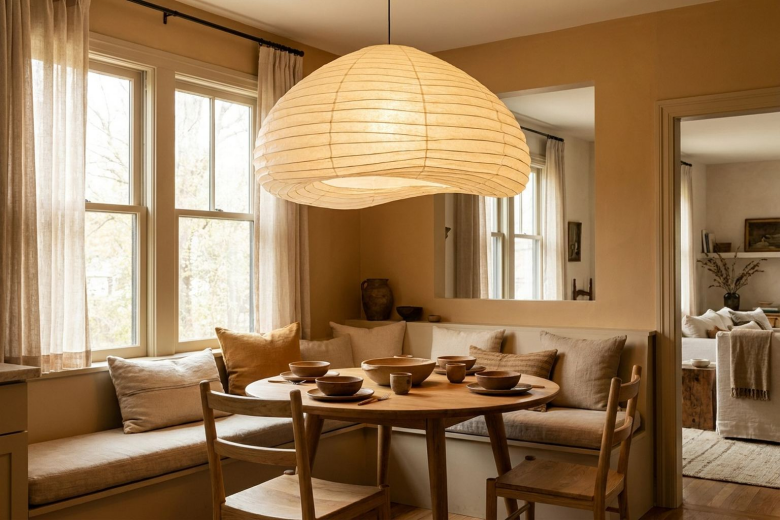
Fixtures a size larger than looks “normal.” Micaela Quinton of Copper Sky Design + Remodel told Livingetc: “Small-scale fixtures can feel safe and lack presence, but large-scale lighting can make a big statement and set the tone in a room.” Murude Katipoglu says, “If the space has generous ceiling heights, don’t be afraid to go slightly oversized.”
Why it works: Tom Raffield says that “one generously sized pendant can actually make a space feel more considered and cohesive… a larger fitting can often give a compact space more confidence and character.” This is a manufacturer’s view, so treat it as a brand perspective.
- Size up one step. Over a dining table, go larger than your instinct says.
- Check clearance. Decorilla suggests flush mounts where pendant clearance is limited.
- Use one big fixture, not many. It anchors the room.
- Balance with small lamps. Table lamps pull light down.
- Consider paper. Large paper pendants are lightweight and affordable.
Budget options: Livingetc lists an H&M large rice paper pendant at £79.99 (95 cm).
Mistakes to avoid: Oversizing in a low-ceilinged room without checking clearance.
The Power of Three: Grouped Pendants
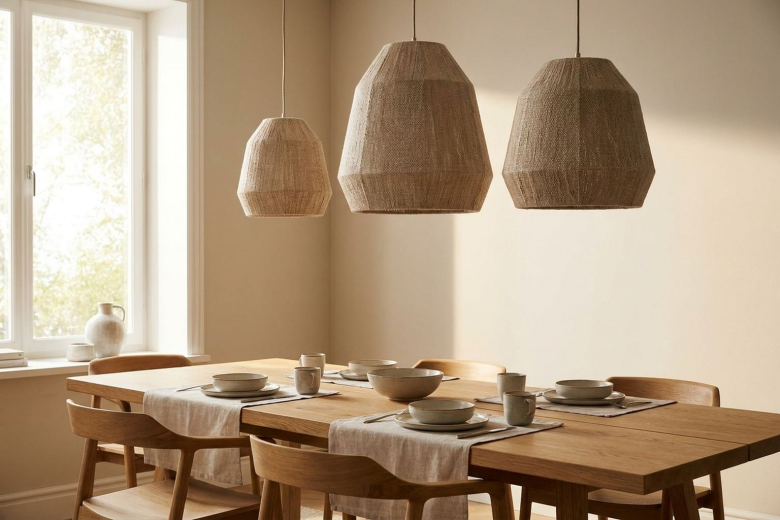
Odd-numbered clusters of pendants, moving from kitchen islands into living rooms, dining tables and stairwells. Tom Raffield says: “Odd-numbered groupings tend to feel more natural; there’s a rhythm and balance to them that doesn’t feel too formal or symmetrical.”
Why it works: Staggered at different heights or in a clean line, three pendants create rhythm without needing a chandelier.
- Use odd numbers. Three or five feels natural.
- Stagger the heights. It adds movement.
- Try a linear trio. One canopy holds three pendants.
- Place over a table or stair. Spaces with a long axis suit it.
- Space generously. Avoid collisions between shades.
Budget options: Linear trio lights consolidate three pendants on one canopy, simplifying wiring. Prices were not captured in the research.
Mistakes to avoid: Spacing shades so tightly that they collide.
Curved, Organic and Asymmetrical Forms

Softer, continuous curves instead of rigid geometry. Michael Jackson of Northern Lights told Livingetc that a key direction from Milan is “the shift away from rigid geometry towards softer architectural language—curved, continuous forms that mirror movement in nature and bring a more human scale to interiors.” Baker says “basic geometric shapes like globes and symmetrical chandeliers have had their moments.”
Why it works: Tom Raffield notes that “curves aren’t just for the ceiling; wall lights can bring in that same softness and dimension, while a curved floor lamp can add a sense of movement to a boxy room or an empty corner.” Houzz reports scalloped tile searches up more than threefold and “arched range hood” up 177%, so curves are trending broadly.
- Add a curved floor lamp. It softens a boxy room.
- Try a curved wall light. It brings softness beside a bed or sofa.
- Pair with straight lines. One curve, one straight.
- Choose asymmetry. A pair that is not an identical match.
- Keep it subtle. Soft, not theatrical.
Budget options: Livingetc lists a Westwing large ceiling lamp, Nebo, at £199.
Mistakes to avoid: Curves in every fixture. Mix with one straight-lined piece.
Natural Materials and Biophilic Lamps
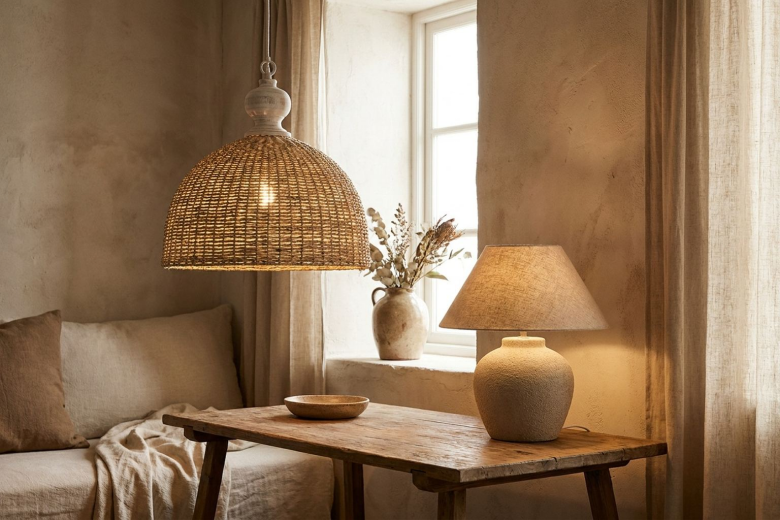
Coconut shell, corn husk, abaca, whitewashed wood and mushroom-shaped shades. Helen Pett of Arteriors told Livingetc: “My favorite lighting trend this season is the shift towards organic materials, such as coconut shells, corn husk, and abaca fibers.” Homes & Gardens says, “In 2027, our lighting is moving in a biophilic direction.”
Why it works: Michael Jackson says Milan Design Week 2026 reinforced “a move towards interiors grounded in natural materials and organic references.” Mara Rypacek Miller of Industville points to “pod-like pendants, seed-shaped bulbs and mushroom-inspired shades.” Google Trends shows “mushroom lamp” up about 21%.
- Choose natural fiber shades. Abaca, rattan and corn husk diffuse light softly.
- Try whitewashed wood. It suits large-scale fixtures.
- Add a mushroom lamp. It is the playful entry point.
- Pair with plants. The biophilic look builds on greenery.
- Avoid damp rooms. Wicker and abaca do not suit bathrooms (writer’s tip).
Budget options: H&G cites an IKEA pleated paper table lamp as a lookalike for the mushroom-lamp trend.
Mistakes to avoid: Using natural fibers where moisture can damage them.
Textured, Murano-Style Glass
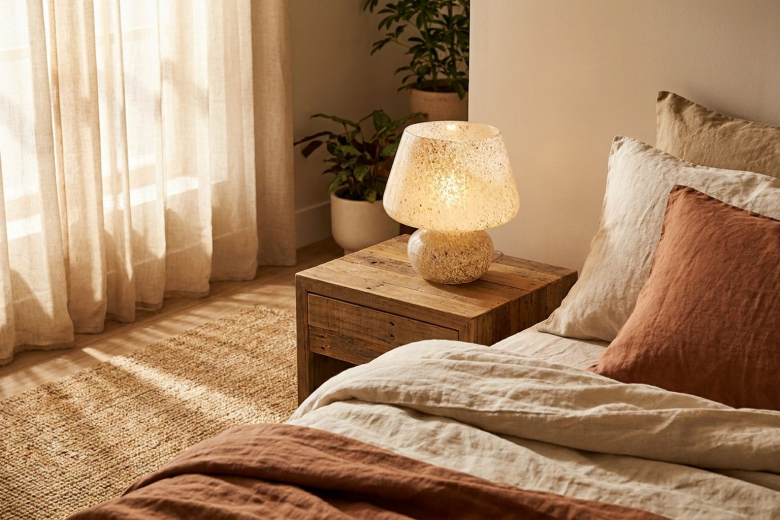
Gently textured, rippled or speckled glass in pendants and sconces. Livingetc says “having emerged as one of the biggest lighting trends of this year, these gently textured, Murano-esque lights are hard to ignore.” Fiona Begley of Barlow & Barlow says the glass “has the gorgeous ability to soften a room and give it a feminine edge… It’s perfect in a dressing room, powder room or bedroom to diffuse light and really calm a space.”
Why it works: Textured glass diffuses light, hides the bulb and adds a handmade quality. Decorilla says Murano-glass pendants led the lighting category in 1stDibs’ 2026 designer survey, though that figure is second-hand.
- Choose diffusing glass. Speckled or rippled glass hides the bulb.
- Use it in intimate rooms. Bedrooms, dressing rooms and powder rooms.
- Pair with warm bulbs. The glass glows amber.
- Try a mocha or amber tint. Livingetc mentions mocha-toned and amber glass.
- Keep the scheme calm. Let the glass be the statement.
Budget options: Look for textured glass shades in high-street ranges.
Mistakes to avoid: Choosing glossy clear glass that shows the bulb.
Aged Brass, Bronze and Art Deco “Newstalgia”
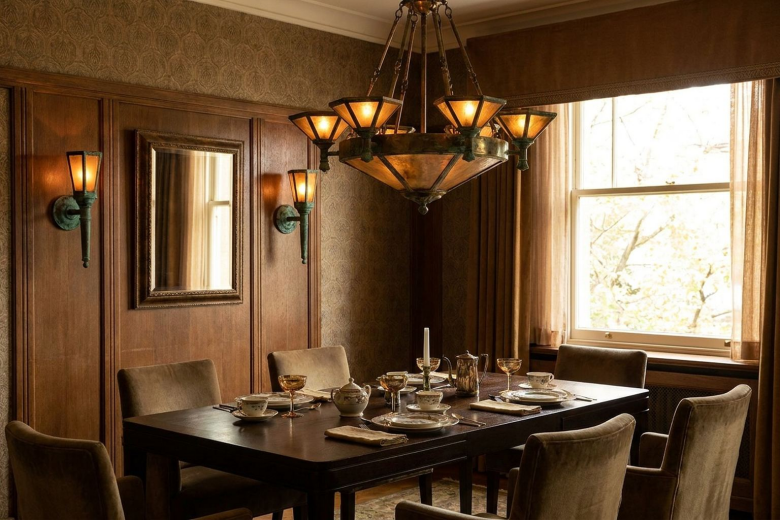
Aged brass, antiqued bronze, copper and early twentieth-century shapes. Mara Rypacek Miller calls it “newstalgia,” in which “contemporary interiors are bringing the raw spirit of early twentieth-century design into the modern era.” Livingetc also sees aged brass and antiqued bronze rising, paired with mocha-toned and amber glass.
Why it works: Decorilla says that “aged brass and bronze are taking a larger share of decorative lighting, joined by finishes in which oxidation becomes visible and desirable.” Tosti says on copper, “a rich patina will develop, and your beautiful project will look simultaneously fresh and as if it’s been there forever.”
- Choose living finishes. Unlacquered metals develop patina.
- Pair with amber glass. The warmth reads as heirloom.
- Start with sconces. Patinated brass sconces are the entry point.
- Mix with stone or plaster. The textures complement each other.
- Repeat the finish. Echo it in a frame or hardware.
Budget options: Soho Home’s Simone chandelier at £3,495 is the splurge. Patinated brass sconces are the practical entry point.
Mistakes to avoid: Buying lacquered “brass” that cannot patina. Ask whether the finish is living or sealed.
Wall Sconces and Cordless Lights

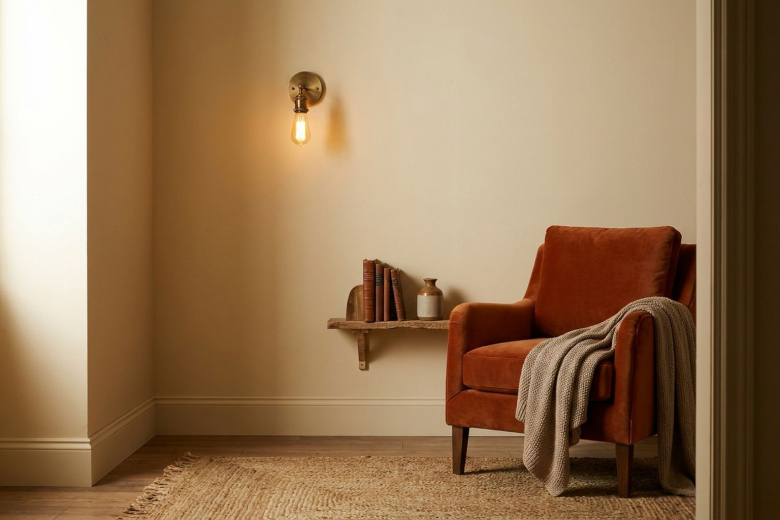
Sconces that create “rooms within rooms,” including cordless, rechargeable models. Kelly Bartley told Homes & Gardens: “In the next year, we’re going to see lighting used more intentionally to create smaller ‘rooms’ within larger living rooms.” She adds that “a single wall sconce can turn an otherwise overlooked nook into its own little retreat… Unlike table lamps, wall sconces do not take up any horizontal real estate.”
Why it works: Google Trends shows related searches for “cordless wall sconce” and “wireless wall sconce” up 200% each, and “rechargeable wall sconce” up 150%. Decorilla says the absence of a cord “allows a lamp to occupy places where wiring would otherwise dictate the composition.”
- Light a nook. Brooke Mennen-Talsma suggests custom upholstered window benches with sconces on each side.
- Go cordless. No electrician, and renter-friendly.
- Free up surfaces. Wall lights save table space.
- Mind the height. Check eye level and glare before installing.
- Choose rechargeable carefully. Check battery life.
Budget options: H&G lists a Pooky Matchbox cordless wall fixture in antique brass at $160.
Mistakes to avoid: Installing decorative sconces without checking projection, eye level and glare, as Finch advises.
Human-Centric and Low-Light Lighting
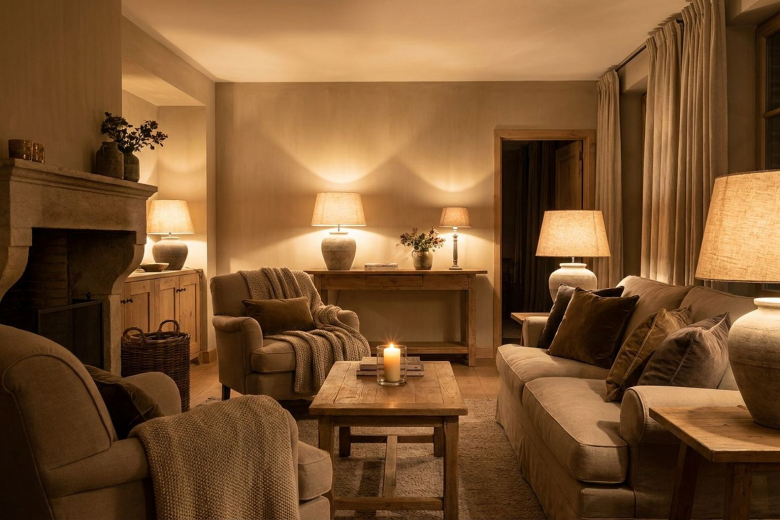
Tunable white light and deliberately lower, warmer rooms. Nicola Fulstow of SONA told Livingetc: “The science is compelling. Light directly regulates cortisol and melatonin production—the circadian rhythm.” Andrew Edwins of PKA Architecture says: “Tunable white lighting allows for the feel of the space to change throughout the day.”
Why it works: Decorilla notes that warm light remains prominent for evening interiors, commonly around 2700K to 3000K. It also lists cool white lighting everywhere and app-only controls with no intuitive switches among trends losing momentum.
- Use warm bulbs in the evening. 2700K to 3000K.
- Try tunable bulbs. Livingetc links a smart bulb as the entry point.
- Keep a switch. Do not rely on an app alone.
- Dim in the evening. Lower light helps wind-down.
- Keep task light. Reading and cooking still need it.
Budget options: A smart bulb is the cheapest way into tunable light.
Mistakes to avoid: Going dark without task light.
Integrated and Picture Lighting
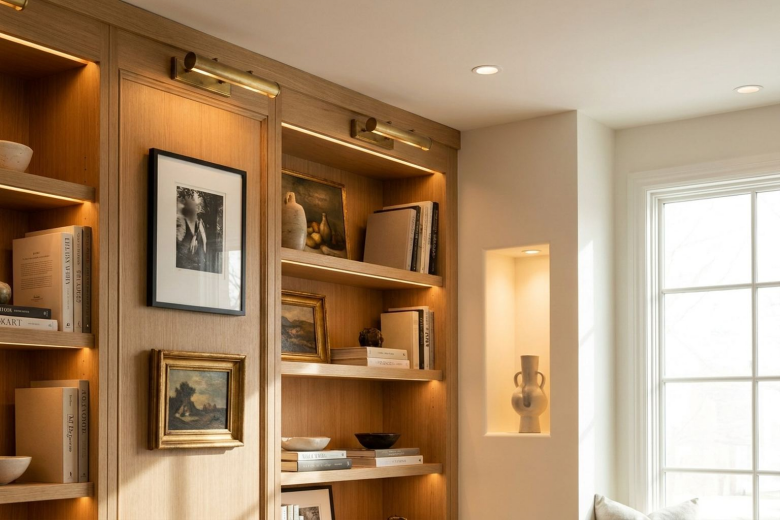
Lighting built into millwork and aimed at art. Eisenhart told Southern Living: “We are integrating it more into millwork and built-in elements to accentuate the architectural details. In this case, it’s less about seeing the fixture and more about the glow.” Peltier says: “I think we’re going to see recessed lighting become smaller and less noticeable… I’d much rather let the beautiful decorative lighting in a room take center stage.”
Why it works: Finch describes picture lights as “a timeless element experiencing renewed popularity” and recommends planning lighting before the walls close.
- Plan early. Integrate lighting before finishes go on.
- Light real art. Finch warns a picture light over random wall decor feels decorative for its own sake.
- Choose small recessed lights. Less visible.
- Check the LED quality. Consider color temperature, dimming quality and serviceability.
- Aim for the glow. Hide the source.
Budget options: Plug-in picture lights are an easy renter solution (writer’s tip).
Mistakes to avoid: Assuming integrated LED is automatically better.
What Is Going Out in 2027
| Fading | Replacing it |
| A grid of recessed lights | Layered lamps, sconces and picture lights |
| Cool white bulbs everywhere | Warm 2700K to 3000K light |
| Basic globes and symmetrical chandeliers | Curved, organic and asymmetrical forms |
| Matching lamp pairs from one catalogue | Vintage and collected lamps |
| Fixtures that disappear into the ceiling | Sculptural fixtures as jewelry |
| App-only controls | Switches plus smart options |
| Small, safe fixtures | Oversized pendants with presence |
How to Combine Trends Without Making a Mess
Mixing six lighting trends in one room can quickly feel chaotic. Use these rules.
Rule 1: Pick one hero and two supports. For example, an oversized paper pendant (hero), a vintage ceramic lamp (support) and a cordless sconce (support).
Rule 2: Keep a 60-30-10 light split. Sixty percent soft ambient light, 30% task light, 10% accent light.
Rule 3: Repeat materials in threes. If you use aged brass, echo it in at least three places.
Rule 4: Mix eras. Pair one vintage lamp with each new fixture.
Rule 5: Give the eye a rest. One statement fixture per zone.
Rule 6: Edit at the end. Turn everything on at night and remove or dim the source that glares.
Three Sample Combinations
- The Collected Living Room: a vintage ceramic lamp, a paper floor lamp, picture lights and warm bulbs on dimmers.
- The Sculptural Dining Room: an oversized pendant, a trio of smaller pendants over the sideboard and a stone sconce.
- The Soft Bedroom: textured glass sconces, a cordless reading light and tunable warm bulbs.
Budget Guide
| Budget | Where to spend | Where to save |
| Under £50 | A paper pendant shade (£5), an IKEA paper lamp (£19), warm bulbs | Everything else: use what you own |
| £50 to £250 | A large paper or rice paper pendant (£79.99), a curved ceiling lamp (£199), a cordless sconce | Reuse existing wiring and fixtures |
| £250 to £1,000 | A thrifted and rewired vintage lamp, stone sconces, a picture light | Mix in secondhand fixtures |
| £1,000+ | A Noguchi-style Akari floor lamp (£780 to £1,010), a designer chandelier, integrated lighting | Accessories can wait and be collected over time |
Prices are as listed by Livingetc in autumn 2026 in UK pounds and vary by retailer.
Smart buying tips:
- Spend most on the fixtures you see every day (a dining pendant, a living room floor lamp) and on lighting that is hard to change (integrated, hardwired).
- Buy lamps first. They are the cheapest layer and the fastest improvement.
- Vintage and secondhand lamps give the collected look authentically and cost less, but budget for rewiring.
Step-by-Step 2027 Lighting Refresh
- Define how you use the room. Reading, dining, TV, entertaining.
- Choose your mood words. Three words, such as “warm, layered, calm.”
- Switch off the overhead. See what the room looks like with only lamps.
- Pick the hero. One sculptural fixture.
- Plan three heights. Floor, table and wall or ceiling.
- Choose warm bulbs. 2700K to 3000K, all matching.
- Add dimmers or smart bulbs. Control at the switch.
- Add accent light. Picture lights and sconces.
- Place lamps in pockets. At least two to six, per Peltier.
- Edit. Live with it for two weeks and adjust.
Styling the Trends by Room Size and Layout
Trends behave differently depending on the room you have. Here is how to adapt the ideas above.
Small Living Rooms (under 150 sq ft)

- Use wall sconces. They take no horizontal space.
- Try mini lamps. Google Trends shows “mini lamp” searches up 400%.
- Choose one hero. A single sculptural piece is enough.
- Go cordless. No wiring and flexible placement.
- Keep warm bulbs. Warm light makes small rooms cozy.
Open-Plan Living Rooms
- Create rooms within rooms. Kelly Bartley’s idea: sconces and lamps define zones.
- Match finishes across zones. Repeat brass or stone.
- Vary ceiling-height light. A pendant over the table, lamps at the sofa.
- Avoid too many statements. Finch warns against mixing too many statement fixtures in an open-concept space.
Large or High-Ceilinged Rooms
- Go oversized. Generous ceilings suit larger fixtures.
- Layer low light. Floor and table lamps bring the glow down.
- Group pendants. Three over a long table or stair.
- Use picture lights. Large walls need accent light.
Rentals and Temporary Homes
- Use cordless sconces. No wiring needed.
- Swap shades. Paper or linen shades change a lamp.
- Use plug-in picture lights. Easy and removable.
- Rely on lamps. They move with you.
FAQ
- What is the biggest lighting trend for 2027? Layered, atmospheric lighting with sculptural fixtures, warm bulbs and lamps at several heights, replacing a flat grid of recessed lights.
- How many lamps should a living room have? Amy Peltier says at least two, and four to six can work beautifully.
- What color temperature should I choose? Warm 2700K to 3000K for evening interiors, according to Decorilla.
- Are cordless lamps worth it? They are good for renters and awkward spots. Google Trends shows searches for cordless and rechargeable lamps rising.
- Are recessed lights out? Designers say rooms filled with them are fading, but small, unobtrusive recessed lights still have a place as a secondary layer.
- Is brass still in? Aged and patinated brass and bronze are rising, while lacquered finishes that cannot patina are less desirable.
- How can I follow lighting trends on a small budget? Buy lamps, paper shades and warm bulbs, and try thrifted lamps with new shades.
- How do I make a room feel cozy with lighting? Use several low sources, warm bulbs, dimmers and wall sconces, and switch off the overhead light.
Final Thoughts / Thumbnail:
The 2027 lighting story is not about buying a new fixture. It is about building a home that glows softly at night, feels warm at the edges and makes every corner usable. Start with the trend that feels most like you, whether that is a vintage ceramic lamp, a paper pendant or a cordless sconce, and build outwards slowly.