
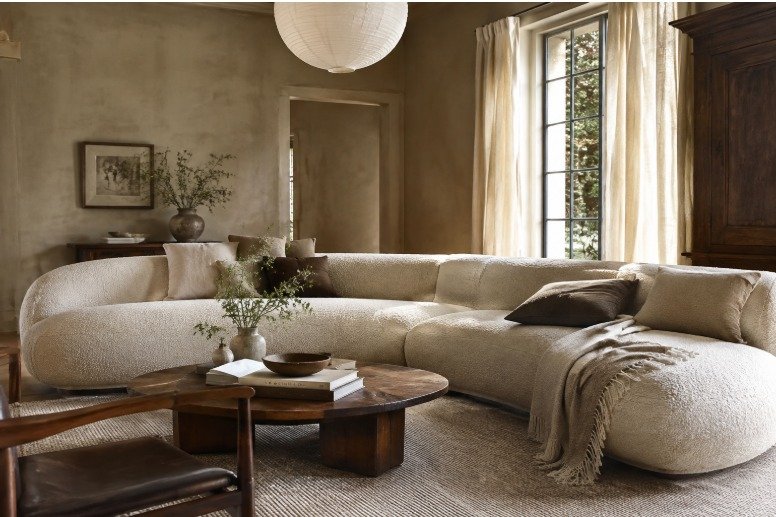
The defining 2026 living room decor trends are comfort-first, personality-led and deliberately imperfect. Expect low, deep sofas in tactile fabrics, book-drenched walls, mixed stone and ceramic surfaces, grandmillennial trims and skirted furniture, tonal “color capping,” moody chocolate and burgundy palettes, art-led schemes, sculptural lighting, warm wood and layered rugs. The common thread: rooms that look collected and feel good to live in, instead of staged for a photo.
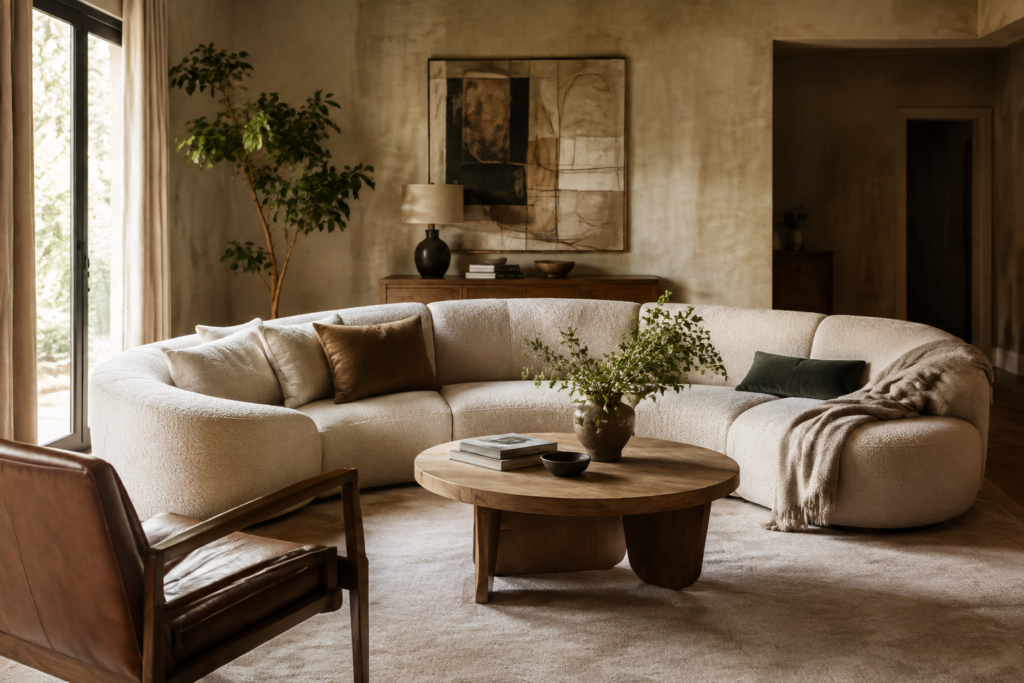
If the last few years were about Instagram-perfect beige, 2026 is the correction. Across House Beautiful, Livingetc, Homes & Gardens, Veranda, Vogue and Country Living, the same message repeats: homes should feel good first and look good second. Vogue describes the mood as “lived-in, time-worn,” favoring authenticity over algorithm-friendly objects. House Beautiful’s designers talk about “dopamine decor,” “intentional clutter” and personal storytelling. Livingetc calls the result “cozy but smart.”
This guide pulls those forecasts together into one practical playbook. For every trend you will find what it is, why it is happening, how to do it in a real living room, what it costs in effort, and the mistakes to avoid. At the end you will find a styling checklist, a budget guide and an FAQ.
The Big Picture: Why Living Rooms Are Changing in 2026
Three forces explain almost every trend below.
1. The home does more work. Homes are now offices, hosting hubs and recovery spaces. House Beautiful’s 2026 forecast puts it plainly: interiors are “trading surface-level style for spaces that actually support how we want to live.” The living room is where that pressure concentrates, because it is used for conversation, television, reading, play, work and entertaining.
2. Fatigue with sameness. Veranda’s editors report a shift away from “fleeting microtrends and catalog-like design,” with homeowners craving a “layered, collected look that celebrates their own style, travels and memories.” Vogue goes further, noting that in a period when AI’s influence over taste feels threatening, a home is an excellent showcase for the human touch.
3. Warmth as a design goal. Better Homes & Gardens reports that when it asked designers about 2026, “warmth” was mentioned more than any other word. Designer Sarah Akbary describes a move away from “cold, over-sanitized spaces defined by smooth, glossy surfaces,” towards “warmth, imperfection, and tactility: medium-toned woods, limewashed plaster, unlacquered metals, layered textiles.”
Keep those three ideas in mind. When you are deciding whether a trend suits you, ask: does it make the room more comfortable, more personal, or warmer? If it does none of those, skip it.
Book Drenching
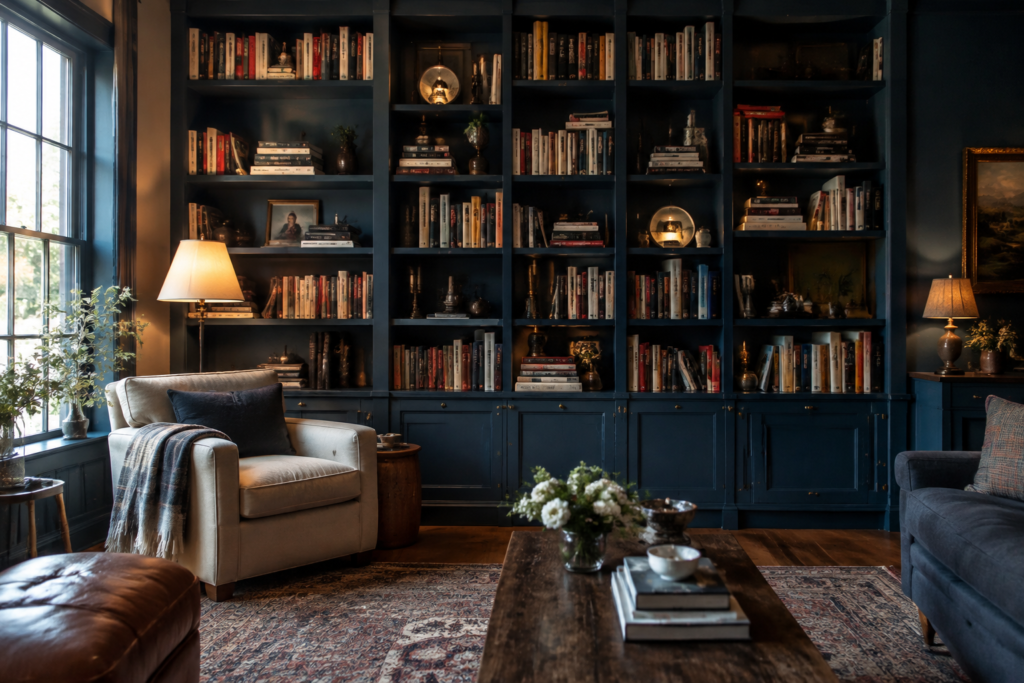
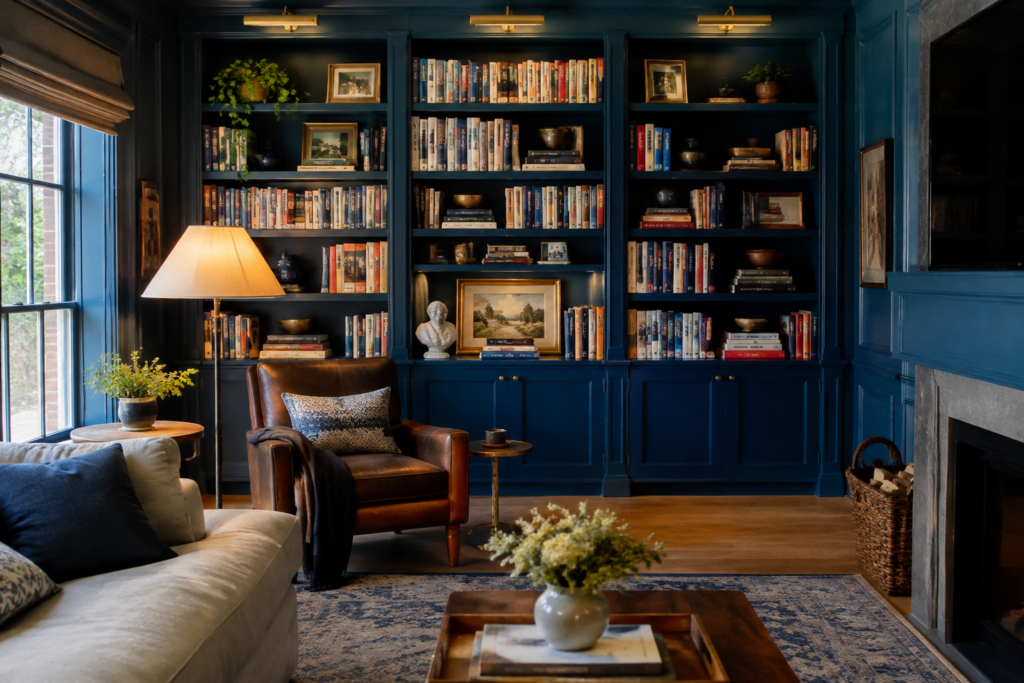
Shelving that takes over an entire wall, or wraps the upper perimeter of the room, often painted in a rich color and packed with books and objects. Homes & Gardens calls it “book drenching” and includes it in its top ten for 2026.
Living rooms are shifting from screen-centered to conversation-centered. A wall of books gives the eye something to explore and adds storage without adding clutter to the floor. Designer Meg McSherry told Homes & Gardens that adding considerable bookshelves and cabinets “instantly creates character and brings a sense of intimacy to a room,” and that displaying your books “tells the story of who you are, where you’ve been, and what’s important to you.”
- Go full height. Built-ins that reach from floor to ceiling and run wall to wall read as architecture, not furniture.
- Paint the shelving. Deep blue, forest green and aubergine are the favorites. Painting the back panel darker than the frame makes objects pop.
- Relax the styling. McSherry’s advice: keep things “relaxed and uncomplicated” so the eye keeps moving. Mix vertical and horizontal stacks, leave gaps, and add a few objects to break up the rows of spines.
- Light it. Picture lights, LED strips under shelves or a nearby reading lamp turn a bookcase into a glowing feature at night.
- Add a ladder or a chair. A rolling library ladder or a cozy reading chair in front makes the wall feel used.
Budget options: Semi-custom built-ins using cabinet-grade shelving units, trimmed with crown molding and painted, deliver the look for a fraction of custom joinery. Renters can line up tall freestanding bookcases of the same size and paint them the same color.
Mistakes to avoid: Overstyling every shelf, arranging books purely by color unless that is truly your look, and leaving the shelves unlit.
Mix-and-Match Stone
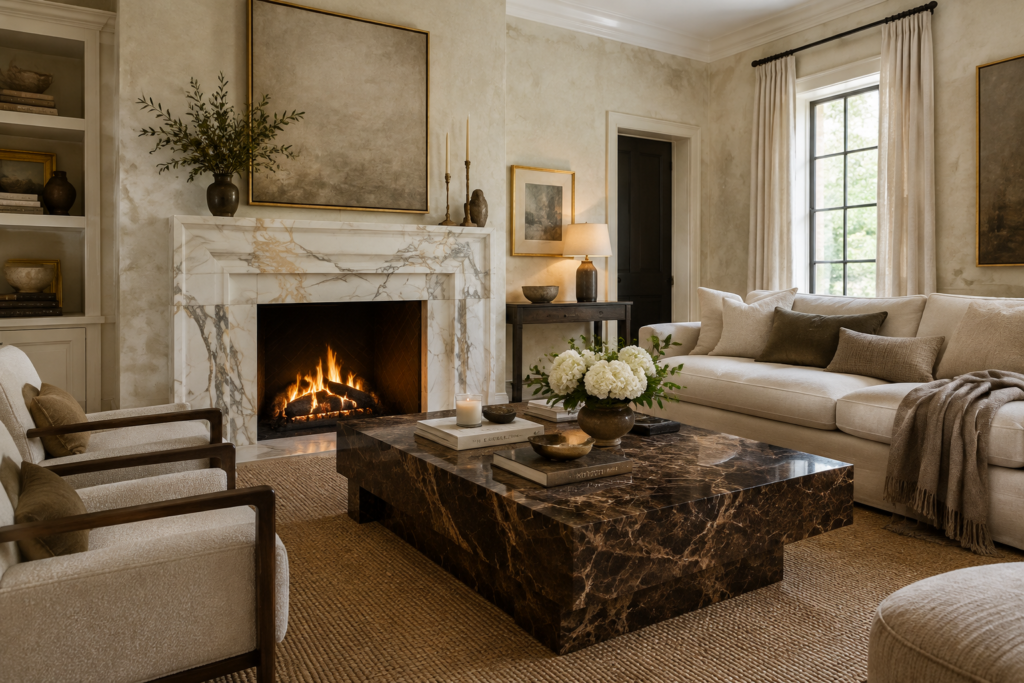
Combining two or more stones in the same room, such as a pale veined marble fireplace with a dark marble coffee table and a travertine side table. Livingetc names mix-and-match stone as its first living room trend for 2026, noting that mixing stones “multiplies the textural and color-led interest” the material delivers.
A designer example: Kristin Harrison of Georgia & Hunt paired limewashed walls and a Calacatta Gold fireplace with a Spanish Dark Emperador marble coffee table “to help ground the space.” She notes the earthy brown tone is “a great alternative to wood.”
- Pick a dominant stone (the fireplace surround or a large table) and a supporting stone in a clearly different tone. Avoid two near-matches, which look like a mistake.
- Keep finishes consistent. Honed or matte stone is warmer than polished, and matches limewash and plaster.
- Repeat each stone twice. If you use travertine on the coffee table, echo it in a lamp base or a tray so it feels planned.
- Soften with textiles. Stone is hard and cool; balance it with wool, bouclé or linen.
Budget options: You do not need a stone fireplace. Marble or travertine side tables, stone lamps, a honed stone tray and a small stone-topped console provide the effect. Faux-stone paint finishes work on smaller surfaces.
Mistakes to avoid: Mixing more than three stones, pairing polished with rough without intention, and ignoring weight. Stone furniture is heavy, so check floor and delivery access.
Ceramic Surfaces
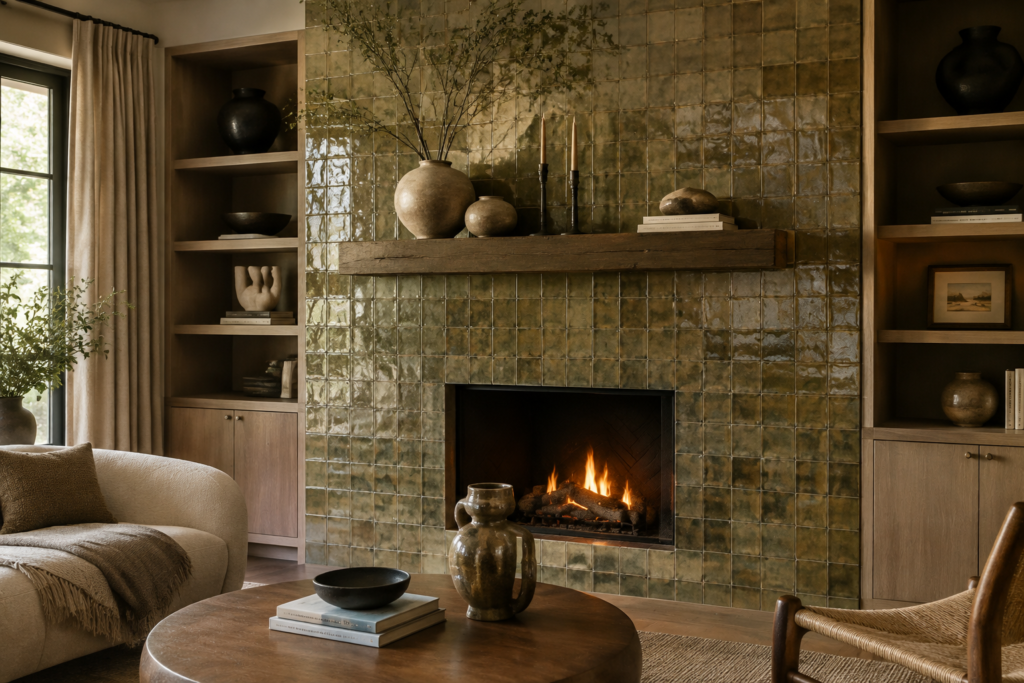
Ceramic used as a statement material beyond the kitchen and bathroom: glazed tile fireplaces, ceramic-clad walls, sculptural ceramic lamps and oversized hand-thrown vessels. Livingetc highlights designer Laura Gonzalez, who introduced a bespoke fireplace wall of ceramic in a living room, and notes that the appeal is “natural and organic elements, and pieces that tell a story.”
Why it works: Handmade ceramics have color variation, glaze pooling and small irregularities. In a year when imperfection is prized, those flaws are the point. Ceramic also reflects light differently from paint or wood, adding depth.
- Start with the fireplace. Zellige-style or hand-glazed tiles in green, terracotta, cream or deep blue around a hearth are the most popular entry point.
- Choose irregular tile. Slightly uneven edges and glaze variations look rich; perfectly uniform tile looks flat.
- Add ceramic lighting. A glazed table lamp with a linen shade is one of the easiest ways to add the material.
- Group vessels in odd numbers. Three vases of different heights on a console or mantel look curated.
- Support local makers. A single commissioned piece gives you the “story” designers keep mentioning.
Mistakes to avoid: Choosing a glaze that fights your wall color, and grout that is too white and busy. Pick a grout tone close to the tile for a softer look.
Grandmillennial Details and Skirted Furniture
A return to the fanciful, “chic grandmother” look: skirted sofas and chairs, floral touches, fringe, cords, buttons, pom-poms and other passementerie, formal sitting areas and fabric-wrapped details. House Beautiful’s list of 2026 living room trends opens with “grandmillennial-worthy details.”
What designers say: Avery Cox told House Beautiful, “A return to the elaborate styles of your chic grandmother is well underway. I’m seeing a renewed love for fanciful upholstery, and I’m thrilled that passementerie is having a true comeback.” She adds that the “era of knife-edge pillows and simple square upholstery is fading as people seek artistry, character, and individuality in their furniture.”
- Choose a skirted piece. A skirted armchair or sofa is the fastest shortcut. Pick a tailored, slightly short skirt for a modern take.
- Add trim to what you own. Tassel or fringe trim can be sewn or glued onto curtains, lampshades and cushions.
- Use florals in a controlled way. A floral curtain or one patterned chair balances solid neutral upholstery.
- Mix with modern pieces. Pair ruffled lampshades with a clean-lined coffee table so the room does not become a costume.
- Think formal sitting area. Two chairs angled towards each other with a small table create a conversation corner.
Mistakes to avoid: Going full theme. The most convincing grandmillennial rooms use two or three nostalgic details inside an otherwise current room.
The Collector’s Living Room
Rooms that display what the owner loves: gallery walls, open shelving, glass-door cabinets and “curiosity” displays. House Beautiful UK describes 2026 as the year the living room “fully embraces collecting,” less maximalism and more “thoughtful curation” that forms a “living archive.”
The furniture shift: Jason Wilary-Attew of John Lewis notes that standalone bookcases are rising “because people now treat bookcases as object cases.” Floating shelves, designed to disappear into the wall, are giving way to shelving that is as expressive as what it holds. Andria Mitsakos of Anthologist describes “piles of edited, deeply personal displays of travel finds, objects with mystery, and sculptural arrangements that tell a story.”
- Choose a display piece with character. A glazed-door cabinet, an antique vitrine or a chunky wooden bookcase.
- Edit by theme, not color. Group ceramics, glass, brass, or travel finds together so each group has a reason.
- Vary scale. Use large, medium and small items; add a stack of books to lift objects to different heights.
- Build a gallery wall slowly. Mix frames, include a mirror and a small shelf, and leave room to grow.
- Rotate seasonally. Changing a third of the display keeps it alive.
Mistakes to avoid: Buying a display “kit” of objects. The whole point is that the objects are yours.
Color Capping and Tonal Decorating
Painting the ceiling and the upper part of the wall (or the ceiling and a band at the top) in one bold tone, often matched to curtains or trim. House Beautiful UK lists “colour capping” as a top living room trend, part of a wider tonal decorating movement. Martha Stewart’s designers describe a related idea, color drenching, where the accent wall is retired and “entire rooms will be saturated in a single hue.”
Why it works: Color capping lowers the visual height of a tall room and makes it cozy, while keeping the lower wall light so the room does not become heavy. Tonal schemes also feel calm because the eye is not bouncing between competing colors.
- Pick a mid-depth color. Rust, terracotta, clay pink, olive and mushroom work well. Very dark colors are better for drenching than capping.
- Decide where the cap stops. A picture rail, a molding line or a clean line at about two-thirds height.
- Match soft furnishings. Curtains in the same or a slightly deeper tone make the scheme feel intentional.
- Sample at three times of day. Warm colors shift dramatically in natural and artificial light.
- Use a matte or chalky finish to hide imperfections and absorb light.
Mistakes to avoid: Choosing a cap color that clashes with the floor. Lay a sample board next to your flooring and sofa before committing.
Chocolate Brown, Burgundy and Moody Palettes
A shift from gray and white to rich, saturated shades: chocolate brown, burgundy, garnet, plum, emerald and deep sapphire. Veranda notes that “the color palette has turned moody with rich hues of chocolate brown and burgundy flooding our rooms.” Designer Huma Sulaiman told Better Homes & Gardens that she loves “lush, cocooning interiors drenched in sensual colors,” with velvet taking center stage.
Why it works: Dark, warm colors feel enveloping, hide wear, and make lamplight glow. They answer the demand for rooms that feel like retreats.
- Start with the sofa. A chocolate velvet or mohair sofa anchors the room without painting a wall.
- Add burgundy in small doses. Cushions, a lampshade, a throw or an armchair.
- Balance with light neutrals. Cream rugs, pale curtains and limewashed walls stop the palette getting heavy.
- Layer metals. Unlacquered brass and aged bronze look especially good against brown and wine.
- Use lighting generously. Dark rooms need warm, layered, low-level light.
Mistakes to avoid: Using cool LED bulbs, which make brown look muddy. Choose 2200K to 2700K warm bulbs.
Art as the Starting Point
Instead of starting with a sofa or a rug, designers begin with a piece of art and build the room around it. Veranda reports that architect and designer Lara Apelian sees treasured art becoming “the main focal point and inspiration when designing living rooms.” San Francisco designer Anu Jain says the living room is becoming “a personal gallery: expressive, emotionally resonant, and layered with artisanal pieces that invite you to sit, sip, and stay awhile, rather than collapse and scroll.”
- Choose the artwork first. It can be an original, a print you love or a vintage find.
- Pull three colors from it. Use one for the largest surfaces, one for mid-level pieces and one as an accent.
- Hang at eye level. The center of the piece should be about 57 to 60 inches from the floor, and the bottom of a work above a sofa should sit 6 to 10 inches above the back.
- Give it room. Keep the surrounding wall relatively quiet.
- Light it. A picture light or a directed spotlight gives a gallery feeling.
Mistakes to avoid: Hanging art too high, and choosing art to match your sofa rather than because you love it.
Sculptural and Fringed Lighting
Lighting that works as sculpture: orb pendants, oversized paper lanterns, patinated brass fixtures and fringe or tassel lamps. Vogue’s 2026 guide picks a fringe-tasseled pendant as a signature item, and features In Common With’s Orb pendant in its lead image. House Beautiful UK calls out statement lighting among its seven trends.
Why it matters: Lighting shapes mood more than any other single decision. Warm, low, layered light is the shared recommendation of nearly every designer in the 2026 reports.
How to layer light:
- Ambient: a central pendant or recessed lights on a dimmer.
- Task: a reading lamp beside the chair, a floor lamp behind the sofa.
- Accent: picture lights, shelf lighting and small lamps on consoles.
- Decorative: the sculptural piece that becomes a focal point.
Aim for at least three light sources at different heights in every living room, and put everything on dimmers.
Mistakes to avoid: A single overhead fixture, hanging pendants too high (the bottom of a pendant over a coffee table should sit roughly 30 to 36 inches above the table), and mixing bulb colors.
Low-Slung, Curved, Deep-Seated Sofas
Sofas that sit low, run deep and have soft, rounded or sculptural shapes. Livingetc opens its description of 2026 with “low-slung and deep-seated sofas.” Veranda adds that “overbearing sectionals have been replaced by more sculptural sofas dressed in lustrous mohair and velvets.” Archiproducts describes organic, fluid shapes as a core 2026 living room direction.
Fabrics to look for: Mohair, alpaca, cashmere blends, velvet, bouclé and richly embroidered textiles. Designer Kathryn M. Ireland told Veranda these fabrics will make seating “more generous, deeper, more inviting.”
How to choose:
- Depth: 38 to 42 inches is the new comfortable range; test by sitting with your legs up.
- Seat height: Low seats feel relaxed but can be hard for older family members. Try before you buy.
- Arrangement: Float the sofa away from the wall to create a conversation zone and give circulation.
- Pair with a round table. A round or oval coffee table softens the silhouette and is safer in tight rooms.
- Fabric practicality: Performance versions of velvet and bouclé exist. Ask for a cleanability rating.
Mistakes to avoid: Ordering a deep sofa for a small room without measuring door and stair access.
Warm Wood and Dark Wood Furniture
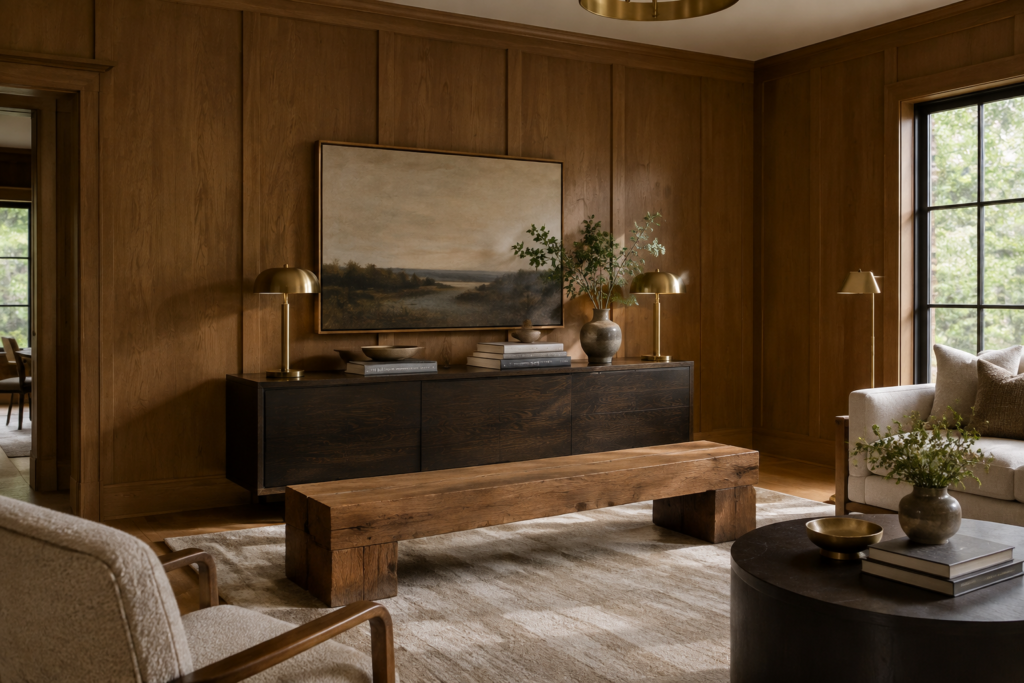
Medium and dark woods return, replacing pale, blonde finishes and painted everything. Country Living’s panel of 100 designers named “the return of wood” among the six standout trends. Vogue highlights the dark wood bench, with a chunky elm console as a reference. Walnut, oak, elm, and stained ash feature heavily.
How to use it:
- Choose chunky, sculptural forms such as a thick-top console, a solid bench or a carved side table.
- Mix wood tones across furniture pieces, but keep an undertone (warm or cool) consistent.
- Add wood paneling. Slatted or reeded panels behind a sofa add warmth and acoustic softness.
- Combine with unlacquered brass. The metal ages with the wood for a lived-in patina.
- Protect the surface. Oil finishes are warm and repairable; lacquer is more durable.
Mistakes to avoid: A room with no contrast. Balance dark wood with light walls, pale textiles or stone.
Layered Rugs and Rich Textiles
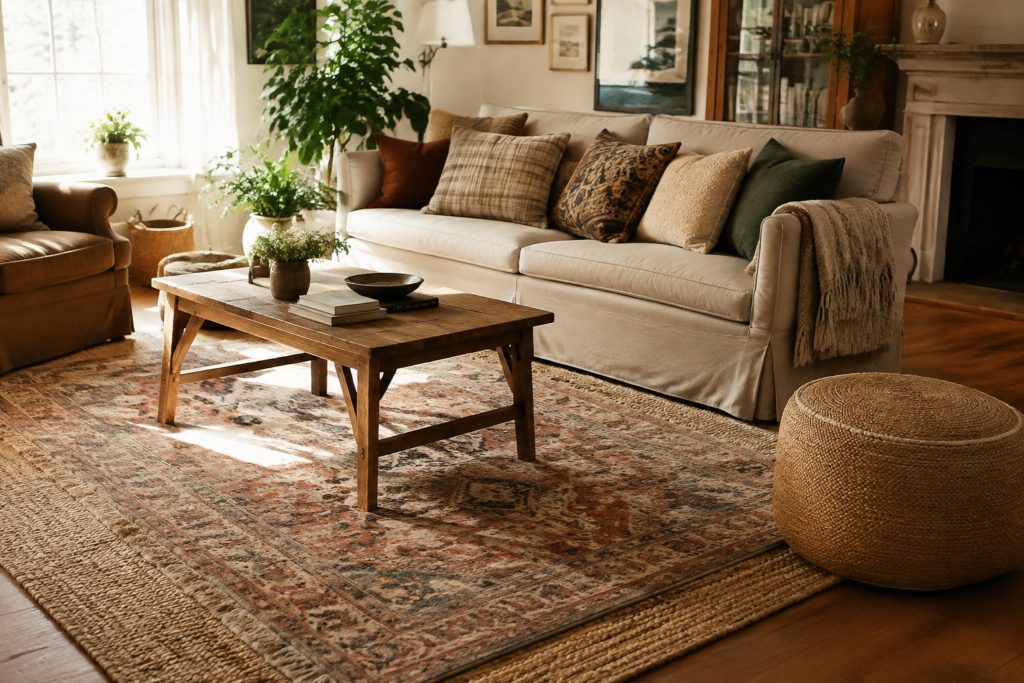
Rugs stacked for texture and pattern, and textiles that take center stage. House Beautiful’s bedroom experts recommend starting with a flatweave base and mixing deep wool pile with coarse jute; the same approach works beautifully in living rooms. Veranda calls textiles “no longer the side characters,” naming mohair, alpaca, cashmere and embroidered fabrics the new heroes. Better Homes & Gardens notes velvet is hugely popular with designers.
How to layer a rug:
- Lay a large, neutral base (jute or flatweave) that extends under all the furniture.
- Add a smaller patterned rug on top, offset slightly rather than perfectly centered.
- Keep the pattern scale different between layers.
- Secure the layers with a non-slip pad to prevent tripping.
Textiles to layer on the sofa: one textured throw, three cushions in different fabrics (for example velvet, embroidered linen and bouclé), and one statement cushion with trim. Hand-dyed and block-printed fabrics bring the handcrafted feel designers are chasing.
Mistakes to avoid: A rug that is too small. The front legs of all seating should sit on the rug at minimum.
Lived-In, Non-Performative Styling
Rooms that are decorated for real use, with visible books, throws, imperfect surfaces and objects that reflect daily routines. Vogue’s Lucy Hammond Giles notes a “growing awareness on social media that decorating should never be just for the photograph,” with more people showing rooms as they are actually used. House Beautiful UK goes as far as declaring “Instagram interiors” over.
- Let your rituals drive the layout. A spot for coffee, a place to drop a book, a lamp beside the reading chair.
- Choose materials that age well. Leather, unlacquered brass, patinated wood and linen all improve with use.
- Keep a few imperfect, handmade pieces. They add soul.
- Remove “staging” items you never use.
- Make space for a dining-chair-style gathering seat. Vogue’s Kendall Knox notes dining chairs have become emblematic of this shift, sitting at the center of “conversation, lingering dinners, homework.”
Warm Minimalism
A softened version of minimalism built on neutral, organic palettes, light oak floors, limewash walls and earthy textures. Apartment Therapy’s experts list warm minimalism among five styles for 2026. Natasha Jain of Bent Collective describes the shift “from minimalism that once felt cold and distant to one that feels lived-in, layered, and warm,” with details such as “the gentle shine of brass, the grain of natural wood, or a candle flickering against a textured wall.”
- Keep furniture count low, but choose tactile pieces.
- Use limewash or plaster finishes on walls for subtle movement.
- Keep the palette to three or four related neutrals (cream, oatmeal, clay, warm gray-brown).
- Add one or two expressive objects so the room does not feel empty.
- Avoid stark white; choose warm whites with yellow or pink undertones.
Archiproducts adds that 2026 living rooms pair “calm through formal restraint” with “warmth and individual accents.” Pantone’s Color of the Year for 2026, Cloud Dancer, a soft, airy white, fits this mood well.
What Is Going Out in 2026
| Fading | Replacing it |
| Cold gray and stark white walls | Warm earthy neutrals, clay, mushroom, deep tones |
| Knife-edge cushions and plain square upholstery | Trimmed, skirted, curved and deep-seated seating |
| Single accent wall | Color capping and color drenching |
| Floating shelves that vanish | Expressive bookcases and object cabinets |
| Glossy, “perfect” finishes | Limewash, honed stone, unlacquered metal |
| Rooms styled for the camera | Rooms styled for living |
| Giant overbearing sectionals | Sculptural, modular sofas |
| Everything matching | Mixed stone, mixed wood, mixed pattern |
How to Combine Trends Without Making a Mess
Mixing six trends in one room can quickly feel chaotic. Use these rules.
Rule 1: Pick one hero and two supports. For example, a book-drenched wall (hero), a chocolate velvet sofa (support) and a sculptural lamp (support).
Rule 2: Keep a 60-30-10 color split. 60% dominant color (walls and large furniture), 30% secondary (curtains, rugs, chairs), 10% accent (cushions, art, objects).
Rule 3: Repeat materials in threes. If you use ceramic, echo it in at least three places at different scales.
Rule 4: Mix eras. Pair one antique or vintage piece with each new piece to avoid a showroom feel.
Rule 5: Give the eye a rest. Each busy zone (a gallery wall, a patterned chair) needs a quiet zone next to it.
Rule 6: Edit at the end. After styling, remove one object from each surface.
Three Sample Combinations
- The Cozy Collector: book-drenched walls, mixed wood furniture, layered rugs, a curiosity cabinet, warm lamps.
- The Modern Grandmillennial: skirted armchair, fringed lamp, floral curtains, a sculptural curved sofa, a marble side table.
- The Warm Minimalist: limewashed walls, low curved sofa, travertine table, one large artwork, a single ceramic vase.
Budget Guide
| Budget | Where to spend | Where to save |
| Under $300 | Paint (color cap), a lampshade with trim, new cushion covers, a thrifted ceramic lamp | Everything else: use what you own |
| $300 to $1,500 | A quality rug, a stone or wood side table, lighting, art | Keep existing sofa, slipcover or reupholster later |
| $1,500 to $5,000 | A deep sofa in good fabric, built-in style shelving, a statement pendant | Mix in vintage and secondhand pieces |
| $5,000+ | Custom built-ins, stone or ceramic fireplace surround, reupholstery with premium fabric | Accessories can wait and be collected over time |
Smart buying tips:
- Spend the most on what you touch daily (sofa, chairs) and on what is hard to change (built-ins, surfaces).
- Buy fabric swatches and sit on floor samples before ordering.
- Vintage and secondhand pieces give the collected look authentically and cost less.
Step-by-Step 2026 Living Room Refresh
- Define how you use the room. List the top three activities. Design for those.
- Choose your mood words. Three words, such as “warm, layered, calm,” will guide every decision.
- Pick the starting point. It could be a piece of art, a rug, a sofa or a paint color.
- Decide on the palette. Use the 60-30-10 ratio.
- Fix the layout. Float the furniture, create a conversation group of 8 to 10 feet across, and leave 30 to 36 inches of walkway.
- Paint. Test samples on two walls and look at them morning and evening.
- Add the big pieces. Sofa, rug, main storage.
- Layer lighting. Three heights, all on dimmers, warm bulbs.
- Add textiles. Curtains hung high and wide, cushions, throws.
- Display and personalize. Art, books, collected objects.
- Edit. Live in it for two weeks and adjust.
Styling the Trends by Room Size and Layout
Trends behave differently depending on the room you have. Here is how to adapt the ideas above.
Small Living Rooms (under 150 sq ft)
- Go tonal. Color capping and color drenching make walls recede and small rooms feel intentional rather than cramped.
- Choose one hero. A single book-drenched wall or one sculptural lamp is enough. Trying three trends in 120 square feet creates clutter.
- Pick a low, compact sofa with exposed legs. Visible floor area makes a room feel larger even when the seat is deep.
- Use round tables. A round coffee table removes sharp corners and improves circulation.
- Hang curtains high and wide. Mount the rod near the ceiling and extend it past the window frame so the window looks bigger.
- Mirror strategically. Place a mirror opposite the window, not opposite clutter.
Open-Plan Living Rooms
- Define the zone with a rug. Layered rugs are the easiest way to mark the seating area without walls.
- Float the sofa. Back it with a console or a low bookcase, which also gives you the “object case” display designers are recommending.
- Repeat materials across zones. If the dining area has dark wood, echo it in the living room so both read as one home.
- Vary ceiling-height light. Use a sculptural pendant over the seating group, with floor and table lamps to pull the glow down to human height.
- Large or High-Ceilinged Rooms
- Use color capping to bring the ceiling down visually and add intimacy.
- Create two or three conversation groups. One main sofa group, one reading corner, and perhaps a formal sitting area in the grandmillennial spirit.
- Scale up art and lighting. Small pieces disappear in big rooms; choose oversized art, large pendants and substantial furniture.
- Add architectural texture. Wood paneling, plaster, or a ceramic fireplace wall gives large walls something to do.
- Rentals and Temporary Homes
- Paint is often allowed with permission; otherwise use removable wallpaper or large fabric panels.
- Freestanding bookcases deliver book drenching without carpentry.
- Plug-in sconces and table lamps create layered lighting without wiring.
- Rugs, throws, cushions and curtains carry most of the warmth and texture. Invest there, because they move with you.
- FAQ
- What is the biggest living room trend for 2026? There is no single winner, but the strongest theme across publications is warm, personality-led comfort: deep seating, tactile fabrics, rich color and collected displays.
- Is gray out of style in 2026? Cold, flat gray is fading. Designers prefer warm neutrals and earthy tones. Warm gray with a brown undertone still works.
- Is minimalism dead? No. It has evolved into warm minimalism: fewer items, but with more texture and warmth.
- What colors are trending for living rooms in 2026? Chocolate brown, burgundy, terracotta, clay, olive and sage, deep blue and emerald, plus warm whites like Cloud Dancer.
- How can I follow trends on a small budget? Paint, lighting, cushions, trims, thrifted ceramics and art are the highest-impact, lowest-cost updates.
- Will these trends date quickly? Trends built on comfort, natural materials and personal objects tend to last. Lean on those and use pure fashion items (specific colors, fringe) in easily changed elements.
- How do I make a living room feel cozy? Layer lighting at low height, add texture, use warm colors, lower the visual ceiling with color capping, and choose deep seating.
- How do I mix patterns? Vary the scale (large, medium, small), share a color across patterns, and anchor with a solid.