
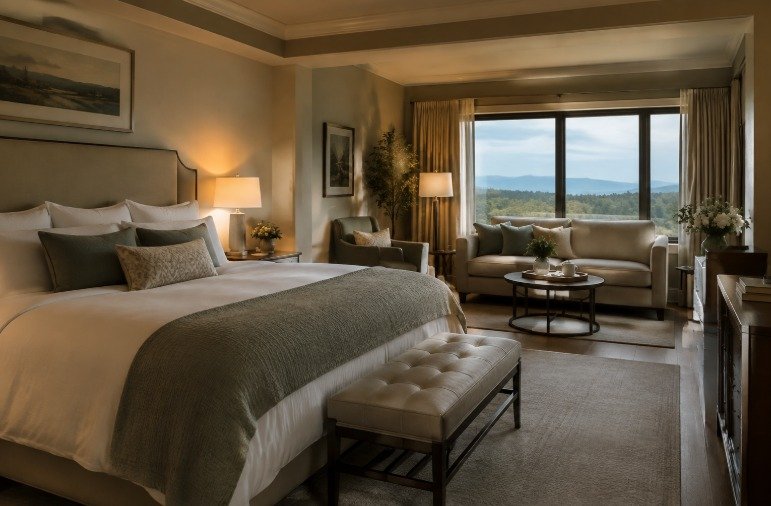
The biggest 2026 bedroom decor trends are “cocooning” rooms wrapped in warm, tonal color; color drenching; burgundy, cocoa and brown palettes; curtains and canopies used as decor; textured ceilings; built-in beds; layered rugs and wall-to-wall carpet; suite-style lounge corners; sculptural headboards; antique and personal pieces; layered warm lighting; and calm Cloud Dancer whites with greenery. The theme behind all of them: the bedroom is becoming a restorative, personal retreat rather than a plain white box for sleeping.
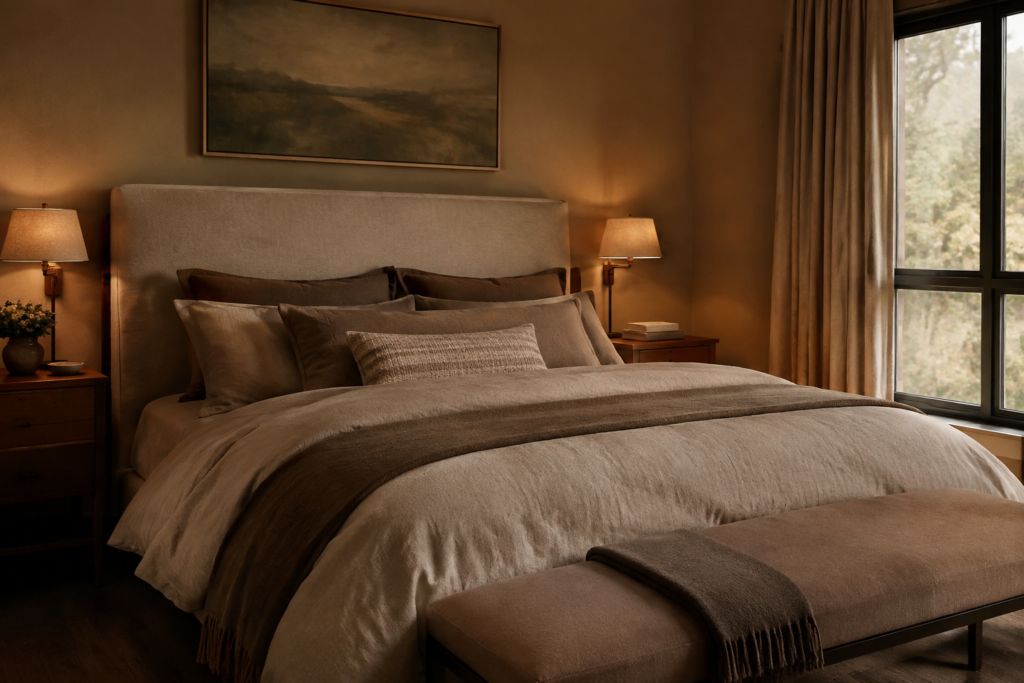
For years, the “correct” bedroom was crisp white bedding, pale walls and a palette of soft blues and greens. In 2026, designers are rewriting that rule. House Beautiful’s experts describe a bedroom “cocooning narrative” built on deep burgundy paint and wallcoverings, dreamy drapery and statement headboards. Veranda says minimalism is out and European-style maximalism is in. The Spruce’s designers want bedrooms that are “cozy, cossetted and relaxing.” Good Housekeeping points to bold wallpapers, earthy palettes and textured ceilings.
This guide pulls together what House Beautiful, Veranda, The Spruce, Good Housekeeping, Martha Stewart, Archiproducts and others are saying, and translates it into steps you can apply. For each trend you will find what it is, why it is happening, how to do it, what it costs in effort, and what to avoid. There is also a budget guide, a layout guide, a bedding and lighting checklist, and an FAQ.
Why Bedrooms Are Changing in 2026
Bedrooms are overdue for attention. Veranda points out that we spend so much time choosing lighting, hardware and paint for common areas that by the time we get back to the bedrooms “we promise to address them at a later date.” Yet the bedroom is where daily restoration happens. In a chaotic world, that matters more.
Comfort has become the brief. Designers interviewed by House Beautiful say bedrooms should feel “completely enveloping”: rich color, layered textures and drapery in unexpected places. The Spruce adds that bedrooms are prioritizing functional style such as smart fans and decorative dressers.
Personalization beats perfection. Martha Stewart’s experts say 2026 bedroom trends “aren’t about what’s new, but about what feels right,” moving away from overly styled looks toward spaces that feel “collected, textured, and deeply individual.” Good Housekeeping also notes a lean into personalization through antique furniture, meaningful art and relaxing palettes.
A useful question for every decision below: does this help me sleep, relax or feel like myself? If yes, keep it.
Cocoon Sanctuaries
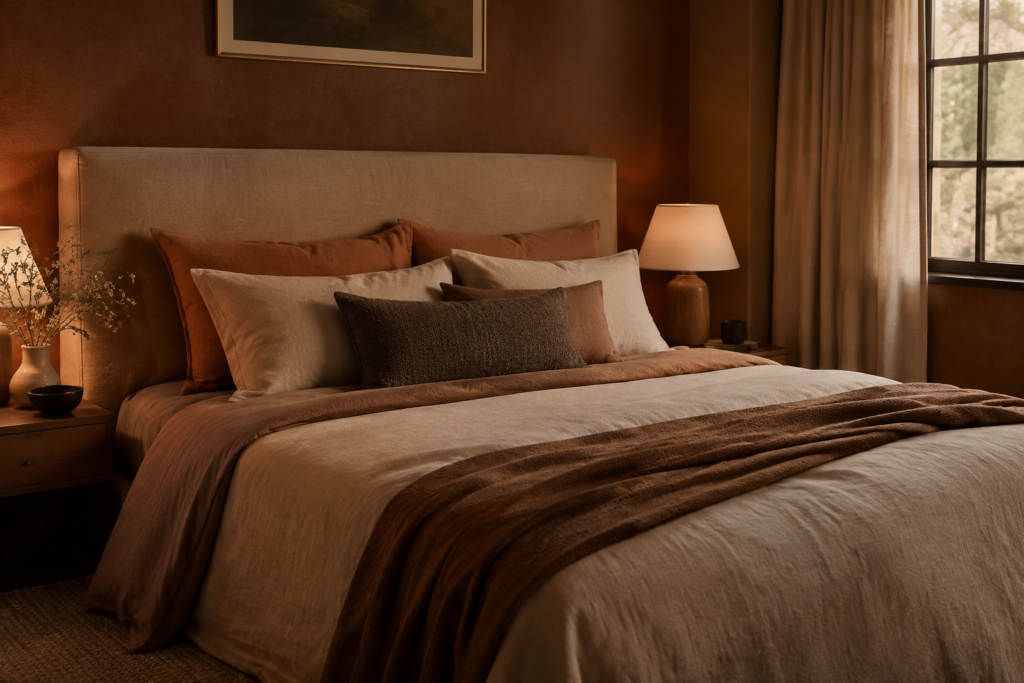
Bedrooms designed to feel enclosed, soft and safe, using warm color, plush textiles and low light. Veranda names “cocoon sanctuaries” as its first bedroom trend. Argent Design’s founder Fontanella says, “Plush bedding, blackout layers, and warm-dim lighting create restful recovery zones.” Alison Hammatt told The Spruce she incorporated dark, textured walls and layers, including herringbone wool wallpaper and quilted bedding, to create a sense of enclosure and quiet that feels “cozy and grounded, rather than stark or airy.”
How to do it:
- Lower the brightness. Use warm 2200K to 2700K bulbs and dimmers.
- Add texture on the walls. Wool wallcovering, plaster, limewash, grasscloth or upholstered wall panels absorb sound and light.
- Go heavy on soft layers. Quilted coverlet, a chunky throw, linen sheets and several pillow sizes.
- Use blackout drapery. Lined curtains improve sleep and add to the cocooning effect.
- Keep the palette narrow. Two or three related tones feel more restful than many colors.
Mistakes to avoid: Cocooning does not mean clutter. Keep surfaces clear and limit decorative objects to a few meaningful pieces.
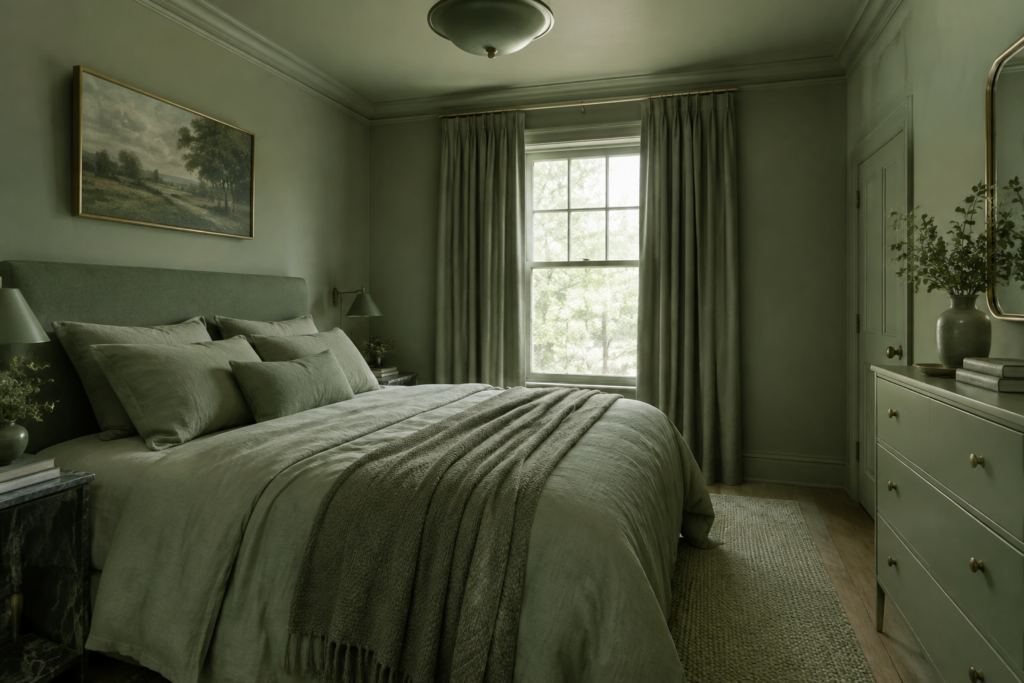
Trend 2: Color Drenching
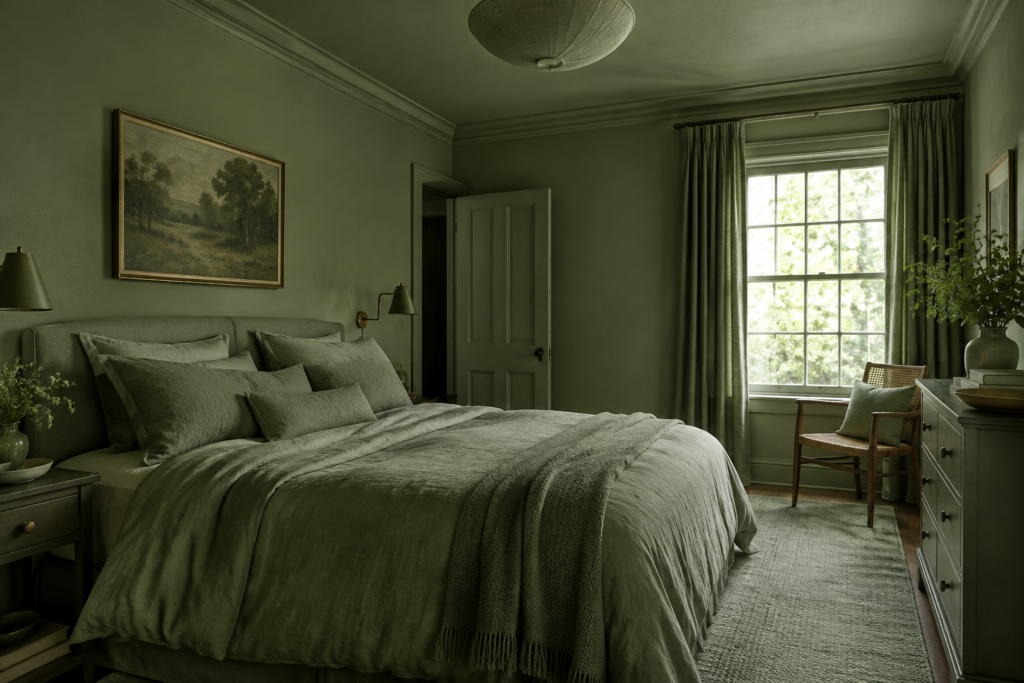
Painting walls, ceiling, trim and sometimes built-ins in a single color. Martha Stewart’s experts say the accent wall’s moment “has officially passed.” Architect Alyssa Anselmo argues accent walls “cut the conceptual flow of a space in half and make a room feel choppy,” whereas painting an entire room one color “creates a cohesive and intentional atmosphere.” Daniel Chenin predicts 2026 will see this taken “further with bolder forms and more nuanced layering,” with rooms saturated in clay pinks, dusty plums and deep sages, with tonal shifts across walls, textiles and furniture.
How to do it:
- Choose one confident hue. Sage green, clay pink, mushroom, dusty plum and inky blue all work.
- Paint everything. Walls, ceiling, trim, doors, and even radiators.
- Vary the finish, not the color. Matte walls, satin trim, eggshell ceiling adds depth without changing the color.
- Layer tonal textiles. Bedding, curtains and rugs in slightly lighter and darker versions of the main color.
- Add a contrast accent. A single brass lamp, a wooden nightstand or a white artwork prevents flatness.
Chenin’s tip for cautious beginners: choose one confident hue and layer textures so the look does not feel flat. A headboard wall that blends into built-in cabinetry, or a ceiling painted to match the bedding, are the examples designers love.
Mistakes to avoid: Testing paint on one small patch. Paint large samples on two walls and check them morning and night; dark and mid-tone colors shift dramatically.
Trend 3: Burgundy, Brown and Earthy Palettes
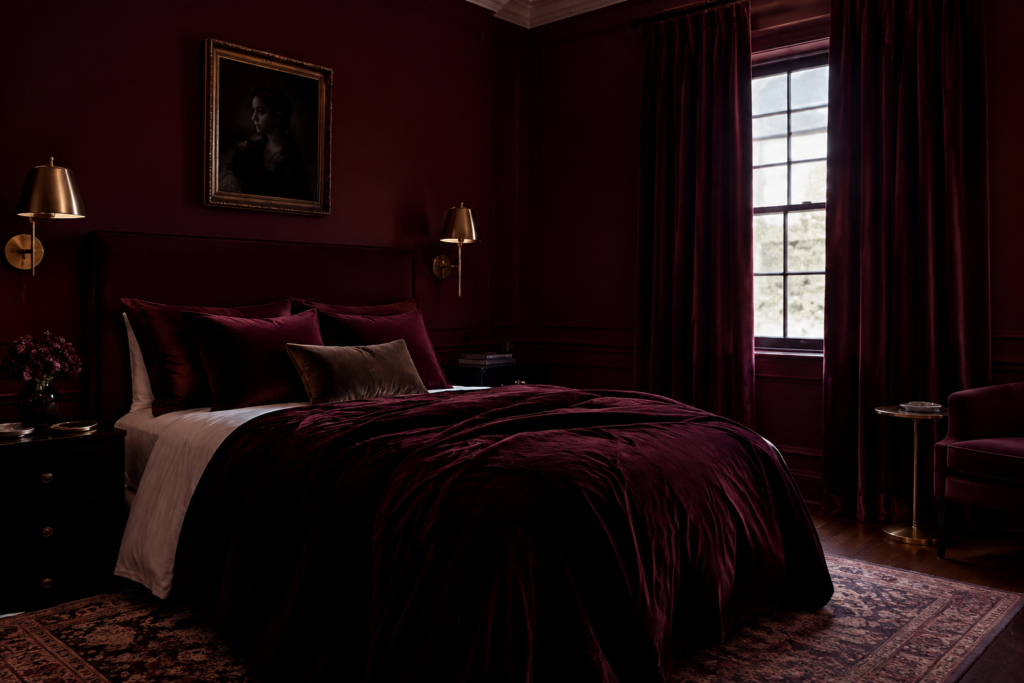
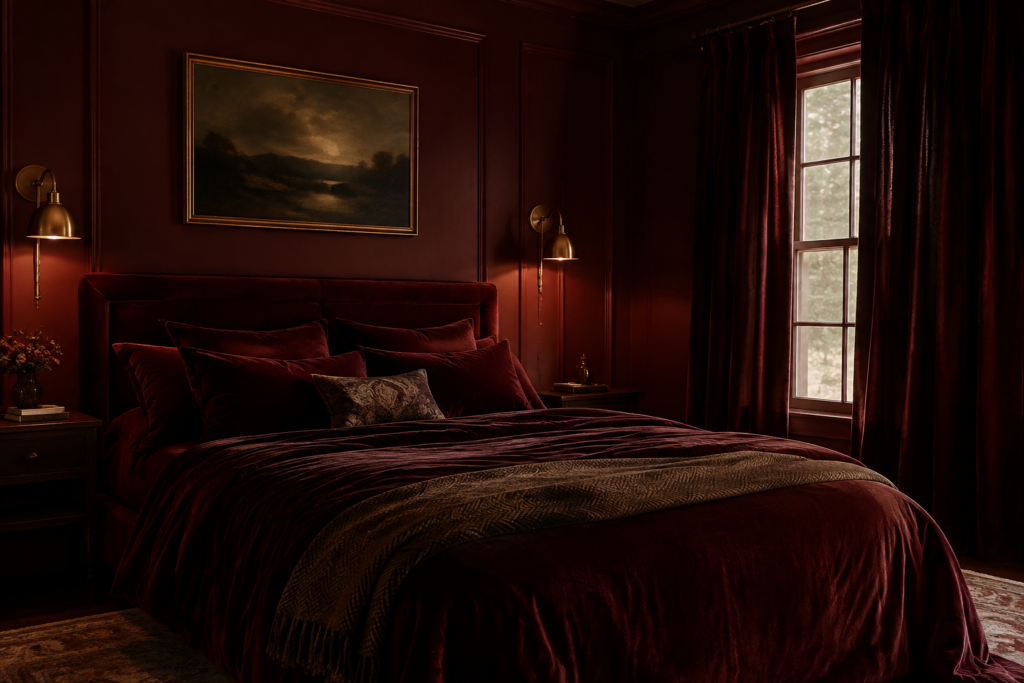
Deep, warm, grounding colors: burgundy, oxblood, cocoa, clay, chestnut and moss. House Beautiful calls out “deep burgundy paint and wallcoverings” as a 2026 bedroom staple. Marie Cloud of Indigo Pruitt Design Studio describes “Earthy Cocooning”: bedrooms “wrapped in tonal palettes that feel both comforting and sophisticated,” where warm hues like cocoa brown and clay bring “a sense of calm that feels like a deep exhale at the end of the day.” Good Housekeeping also features brown as a bedroom color for the year
Why it works: Warm dark colors reduce visual stimulation, feel protective and glow beautifully in low light, which is exactly what you want before sleep.
How to do it:
- Start with bedding. Burgundy velvet, cocoa linen or a chocolate throw is the lowest-risk entry point.
- Add one wall treatment. Burgundy paint, a brown wool wallpaper or a textured plaster finish.
- Balance with warm neutrals. Cream, oatmeal and ivory stop the room from getting heavy.
- Select metals carefully. Aged brass and bronze warm the palette; chrome can feel cold.
- Use wood. Walnut and oak furniture feels natural against brown and wine.
Mistakes to avoid: Using cool-white bulbs, which make brown look flat and gray. Also avoid dark colors on every surface if the room has little natural light; add light-reflecting fabrics and mirrors.
Trend 4: Curtains as the Bedroom Accessory
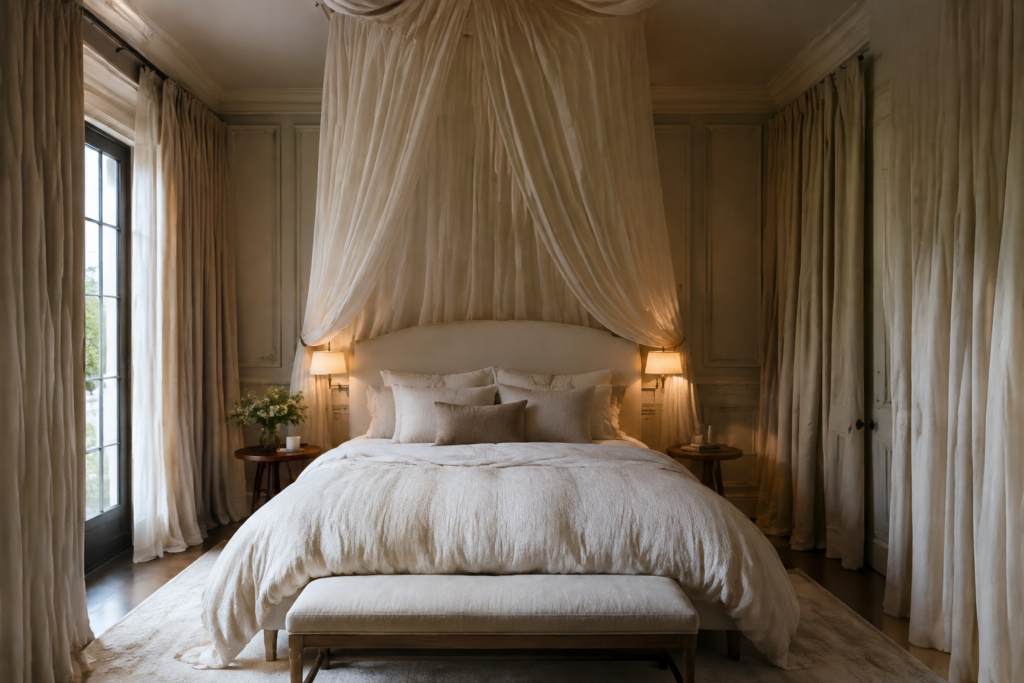
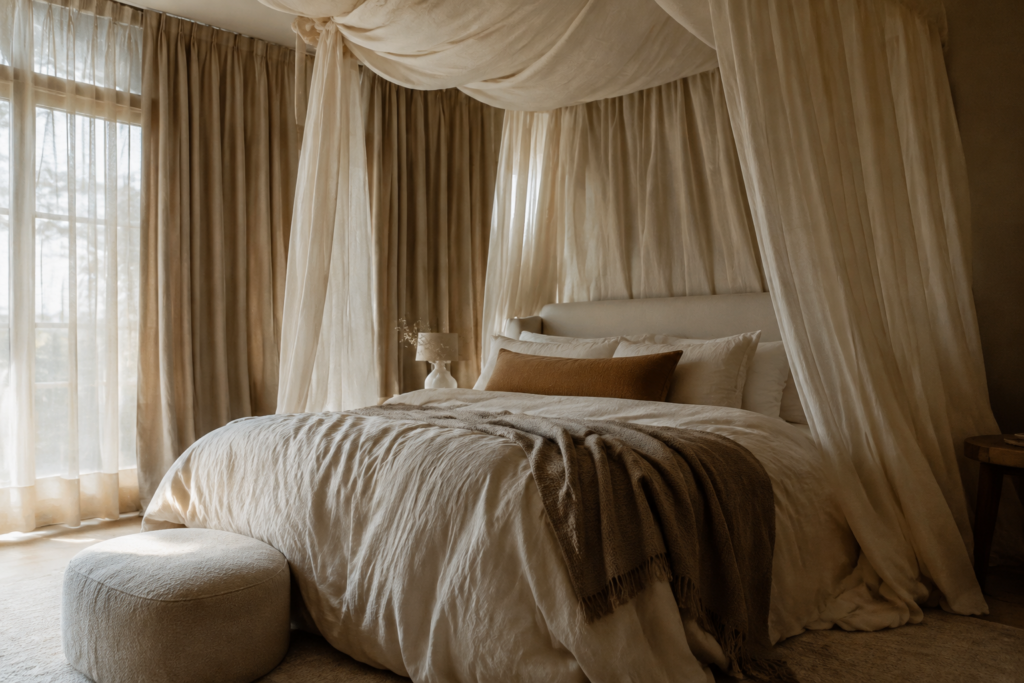
Drapery used as architecture: canopies, bed curtains, curtain-wrapped walls, headboard drapes, and window treatments hung from ceiling to floor. House Beautiful’s headline “Curtains as the Bedroom Accessory” captures it. Haley Weidenbaum of Everhem says, “Designers are using drapery not only to frame windows beautifully, but also to create atmosphere, softness, and architectural interest throughout a space,” and reports a surge in requests for drapes on canopy beds. Leigh Ann Harris of Christopher Architecture & Interiors loves “drapery used in unexpected ways, from canopies to full wall treatments.” Designer Alison Hammatt added softness to a bed with curtains.
How to do it:
- Hang high and wide. Mount the rod close to the ceiling, extend 8 to 12 inches on each side of the window and let fabric reach the floor (or pool very slightly for a romantic look).
- Choose fullness. Aim for two to two-and-a-half times the width of the window in fabric.
- Pick fabrics for mood. Linen for breezy, velvet for drama, lined cotton for practicality.
- Add a canopy. A simple ceiling-mounted rod with fabric on each side of the bed gives the effect without a four-poster.
- Wrap the headboard wall. Floor-to-ceiling curtains behind the bed create a soft backdrop and hide awkward windows.
Budget tip: Ready-made panels, sewn to the right length by a tailor, offer the look at a fraction of custom cost. Line them for better light control.
Mistakes to avoid: Short curtains that stop at the sill, thin fabric with no lining, and rods mounted directly on the window frame.
Trend 5: Textured Ceilings
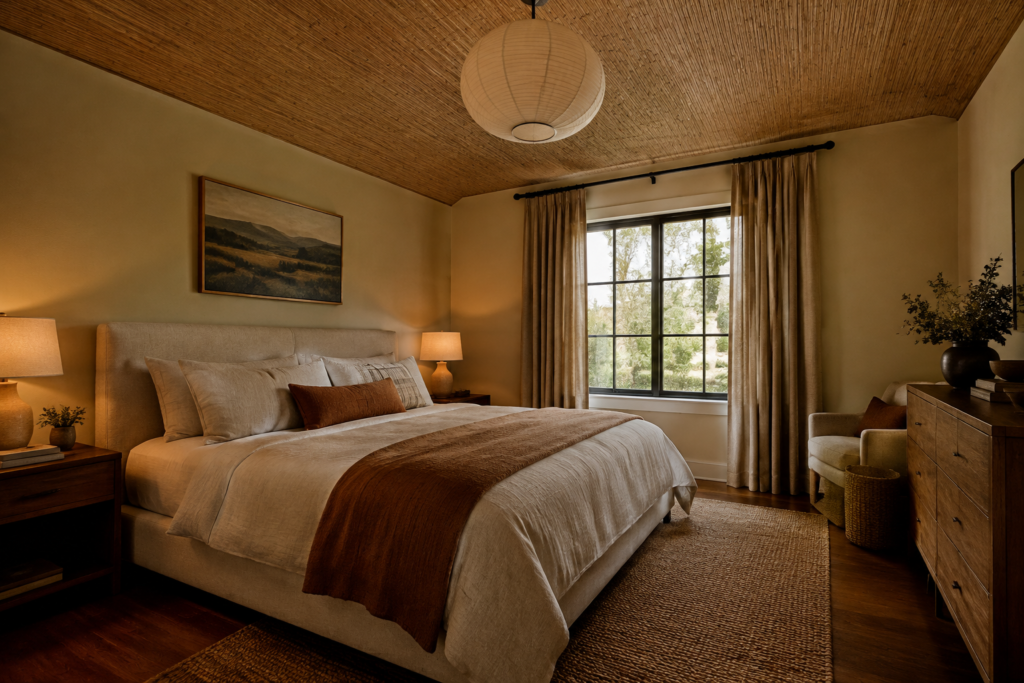
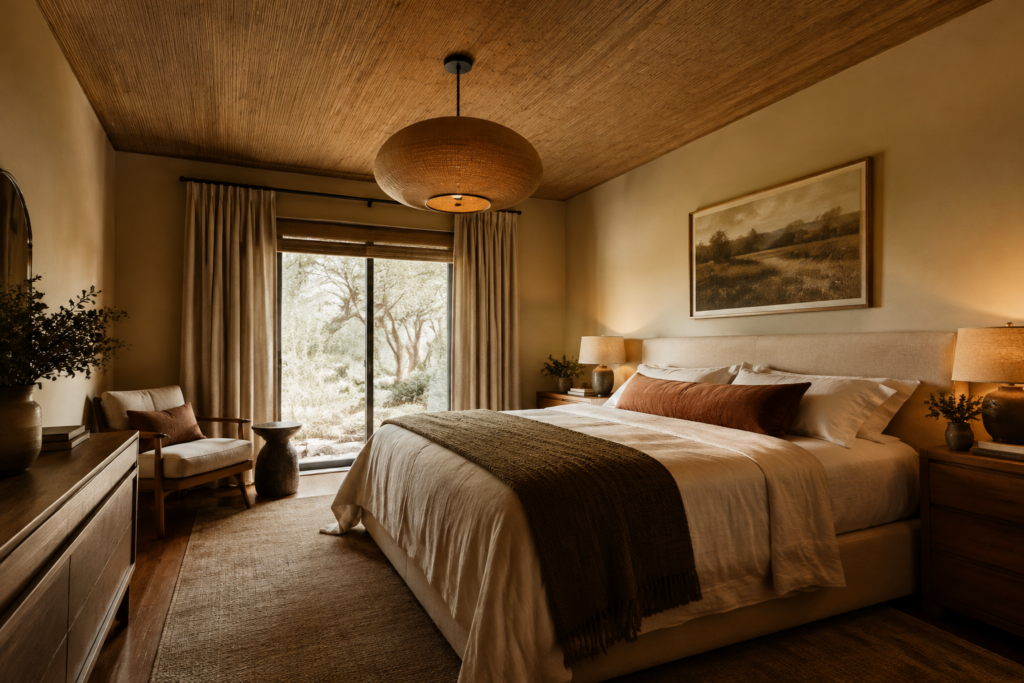
Bringing pattern or material overhead: wood slats, planks, grasscloth, painted beams, plaster, or wallpapered ceilings. Good Housekeeping quotes Paige Williams of Paige Williams Interior Design: “Bedrooms with textured ceilings will be a trend in 2026 because they add depth and character to a space. By bringing pattern or material overhead, ceilings transform from overlooked surfaces into design statements, making even modest rooms feel layered, cozy, and elevated.” Veranda’s Hart Howerton designer Emma Feeney adds that she uses natural white oak on “floors, walls, and ceilings, sometimes all at once.”
Why it works for bedrooms: You spend time lying down, so the ceiling is one of the first things you see. A warm ceiling makes the room feel enveloped.
Options:
| Treatment | Look | Difficulty | Budget |
| Painted ceiling in wall color | Subtle drenched look | Easy | Low |
| Wallpaper or peel-and-stick | Pattern, color | Moderate | Low to mid |
| Grasscloth | Natural, textural | Moderate | Mid |
| Wood slats or planks | Warm, architectural | Hard | Mid to high |
| Exposed or faux beams | Rustic or classic | Moderate | Mid |
| Plaster or limewash | Soft, aged | Moderate | Mid |
Mistakes to avoid: Very dark ceilings in low-ceilinged rooms, and heavy patterns above a busy bed area. Keep the rest calm.
Trend 6: Built-In Beds
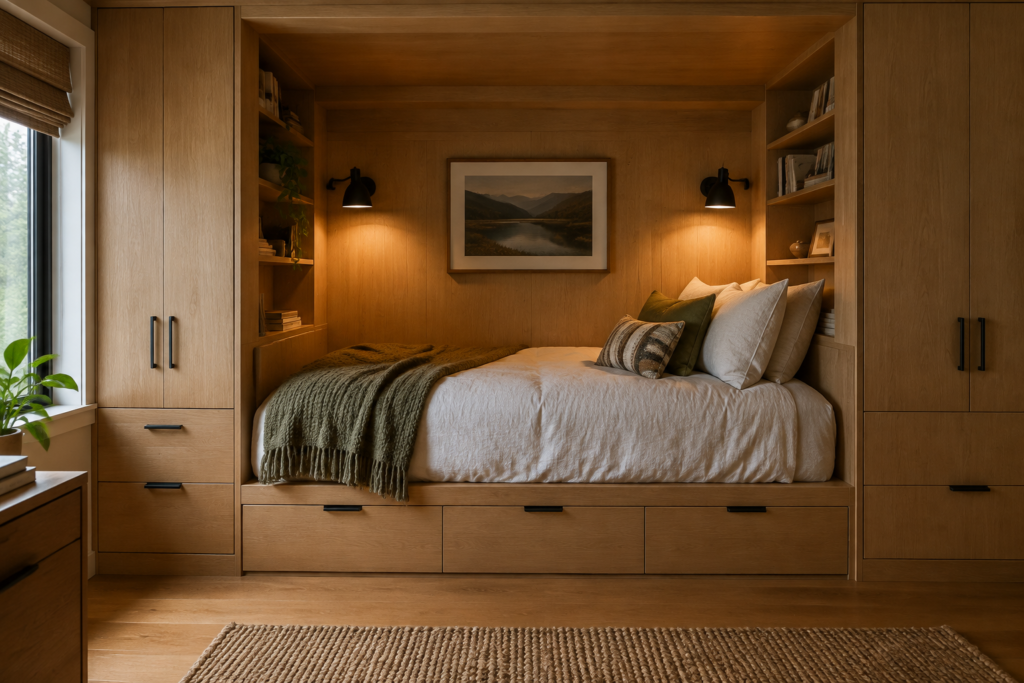
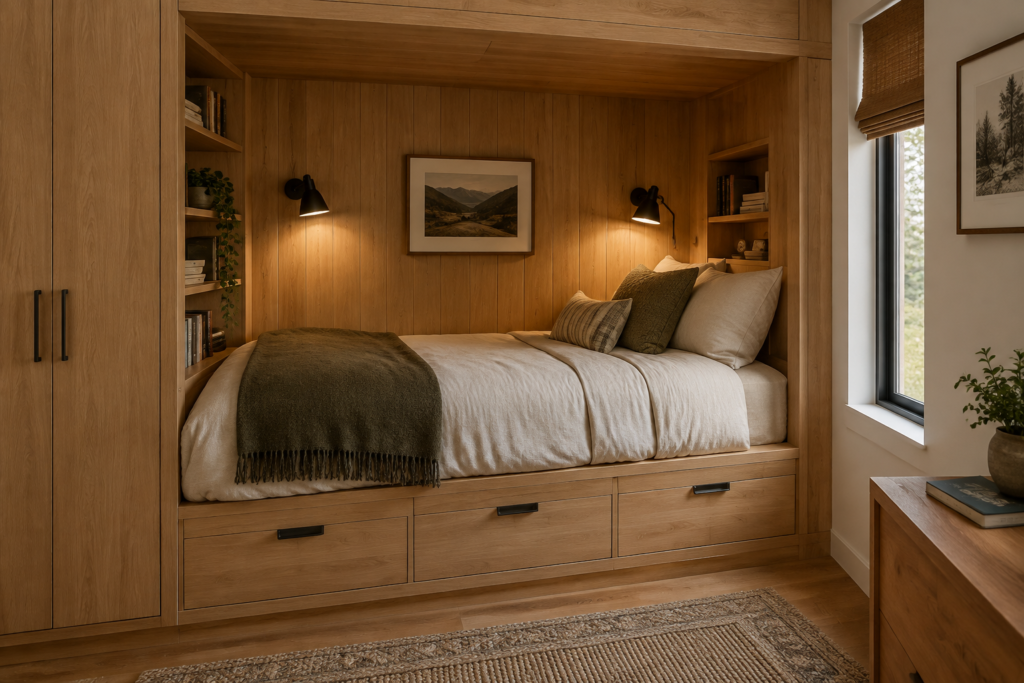
Bed frames integrated into the architecture, often with side storage, niches, shelves or paneling. Martha Stewart’s Alyssa Anselmo says a built-in bed “makes the room feel so grounded,” adding that frames integrated into the architecture “make everything feel intentional and sculptural.” The article also notes practical benefits such as storage.
Why it is popular: It solves the problem of a bedroom that feels like a bed floating in a box. It also provides storage, lighting and a cozy nook feeling.
How to do it:
- Build a surround. Side panels or cabinets flanking the bed, with a bridging shelf or cabinet above.
- Integrate lighting. Reading lights, sconces and USB outlets make the nook functional.
- Add storage. Drawers beneath the bed, side cubbies or cupboards.
- Use paneling. Fluted, shaker or slatted panels provide texture.
- Choose a soft, upholstered back. A padded panel behind the pillows adds comfort.
Budget alternative: A set of freestanding wardrobes on each side of the bed with a shelf bridge, trimmed and painted to match, imitates the look.
Mistakes to avoid: Forgetting about changing sheets. Leave at least 24 inches on the sides, or design for easy access, and allow for mattress replacement.
Trend 7: Layered Rugs and Wall-to-Wall Carpet
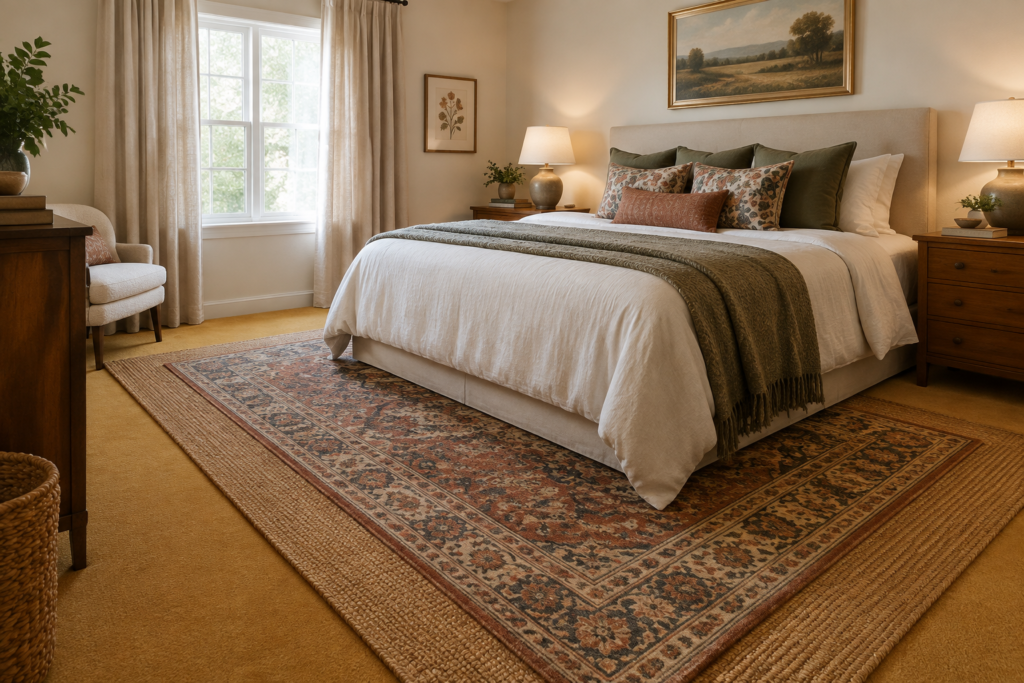
Overlapping rugs for texture, and the return of fitted carpet in color. Brigette Romanek told House Beautiful, “A layered rug is unexpected and eclectic, and it brings this gorgeous energy into the space.” She advises starting with a foundation of a flatweave rug that evokes a hard surface, then adding patterns on top of solids. Bradley Odom recommends pairing a deep wool pile with a naturally coarse rug like jute: “Variation in texture is so important.” David Ries of Ries Hayes embraces statement hues like bronze, butterscotch and deep moss for wall-to-wall carpet.
Trend 8: Suite-Style Bedrooms and Lounge Corners
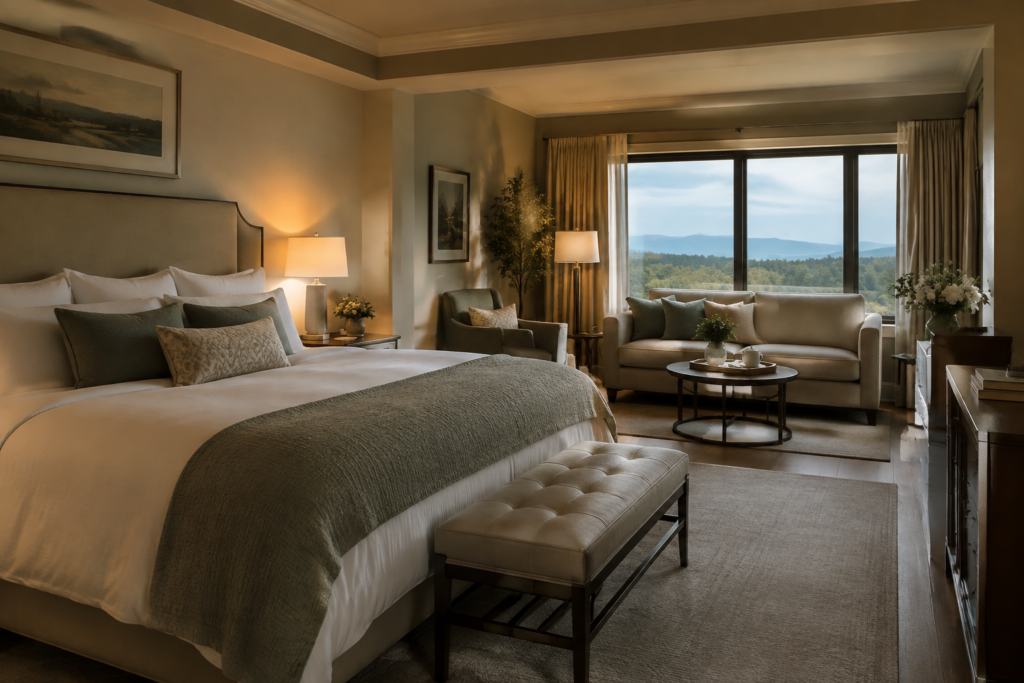
Bedrooms that act like hotel suites, with a seating area for reading, thinking and relaxing. House Beautiful’s 2026 interior trends list features “Suite-Style Living, Reconsidered.” Designer Victoria Armour of Stil James says clients “really want their bedrooms to feel like an escape, a room that functions like a dual-purpose space. Somewhere they can actually relax and feel like they truly have a room just for themselves, beyond simply somewhere to sleep.” These lounge zones are for “reading, thinking, and lingering.”
How to do it:
- Add a chair or small sofa. A lounge chair with an ottoman and a side table beside a window.
- Try a bench or daybed. Even a bench at the foot of the bed can host a tray and a book.
- Include a surface. A small table for tea, a laptop or a plant.
- Build a ritual station. A tray with a carafe, a candle, a journal or a skincare set.
- Keep work out. Avoid a desk facing the bed if you can; otherwise disguise it with a screen or cabinet.
Mistakes to avoid: Crowding a small room. If there is no space for a chair, create a lounge feeling with a bench and a wall-mounted reading light.
Trend 9: Statement Headboards
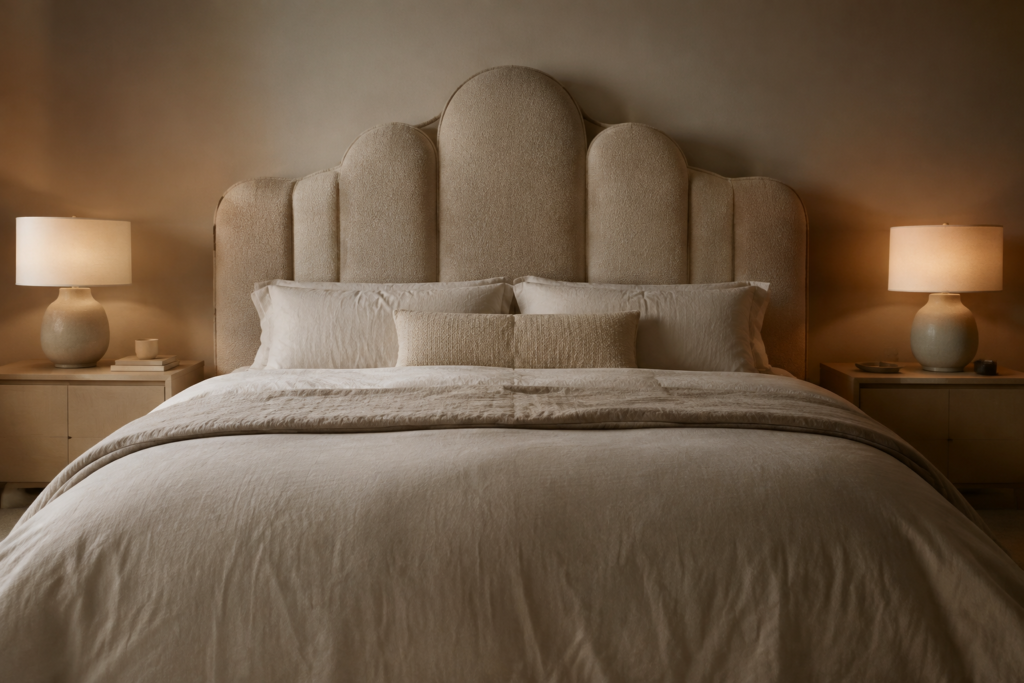
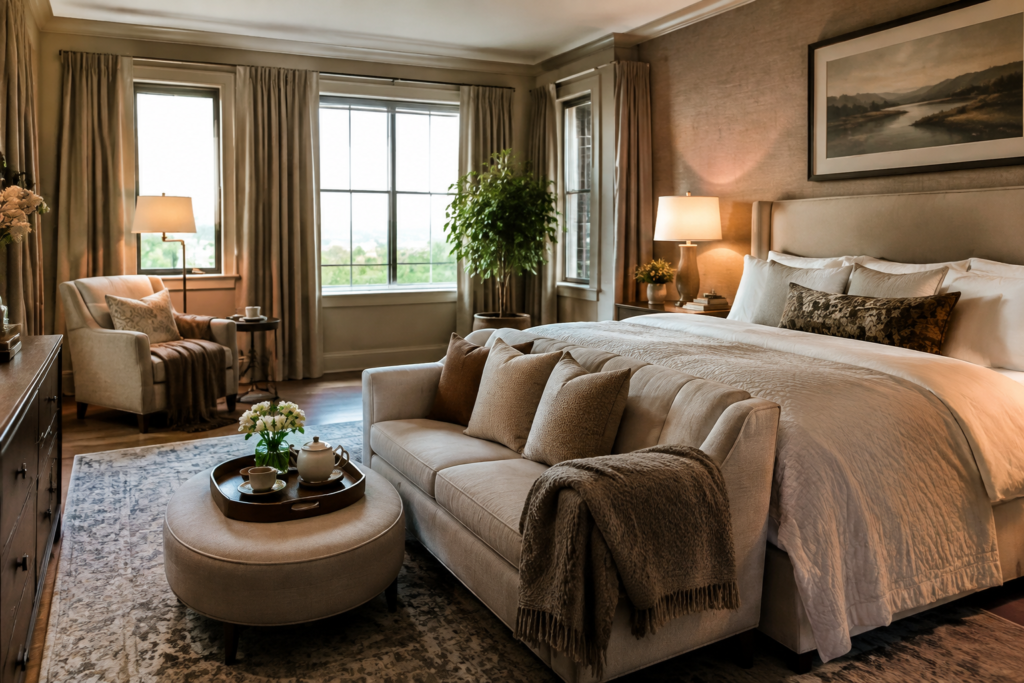
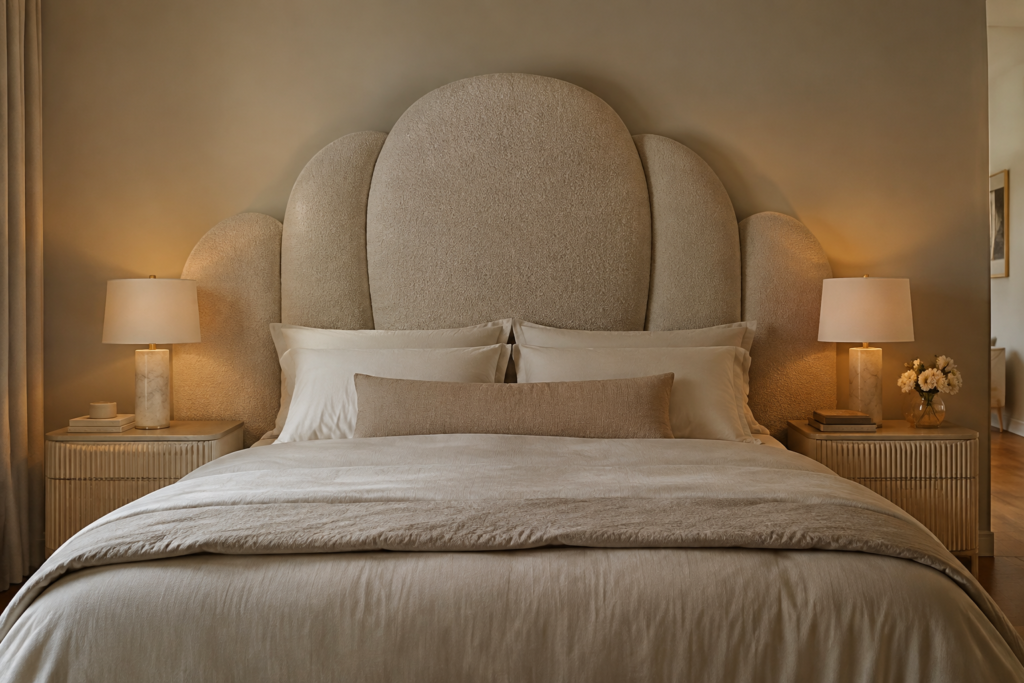
Oversized, curved, tufted, channeled or sculptural headboards that act as the room’s focal point. House Beautiful lists statement headboards among its top 2026 bedroom trends. The piece is often upholstered in tactile fabric such as bouclé, velvet, mohair or embroidered linen.
How to choose:
- Scale up. A headboard that is wider than the bed by 6 to 12 inches and tall enough to reach above your pillows looks luxurious.
- Pick texture over pattern for calm; pattern for personality.
- Think shape. Arches, scalloped edges, curved wings and bolstered tops read as sculpture.
- Match or contrast. Tone-on-tone with the wall for subtle; a contrasting color for drama.
- Check comfort. You will lean on it; test padding and depth.
DIY option: A plywood panel wrapped in batting and fabric, mounted on a French cleat, makes an affordable custom headboard.
Mistakes to avoid: Buying a headboard that is too short for your pillows, or using a fabric that attracts hair and dust without washing options. Choose removable or performance covers.
Trend 10: Cloud Dancer Calm and Living with Greenery
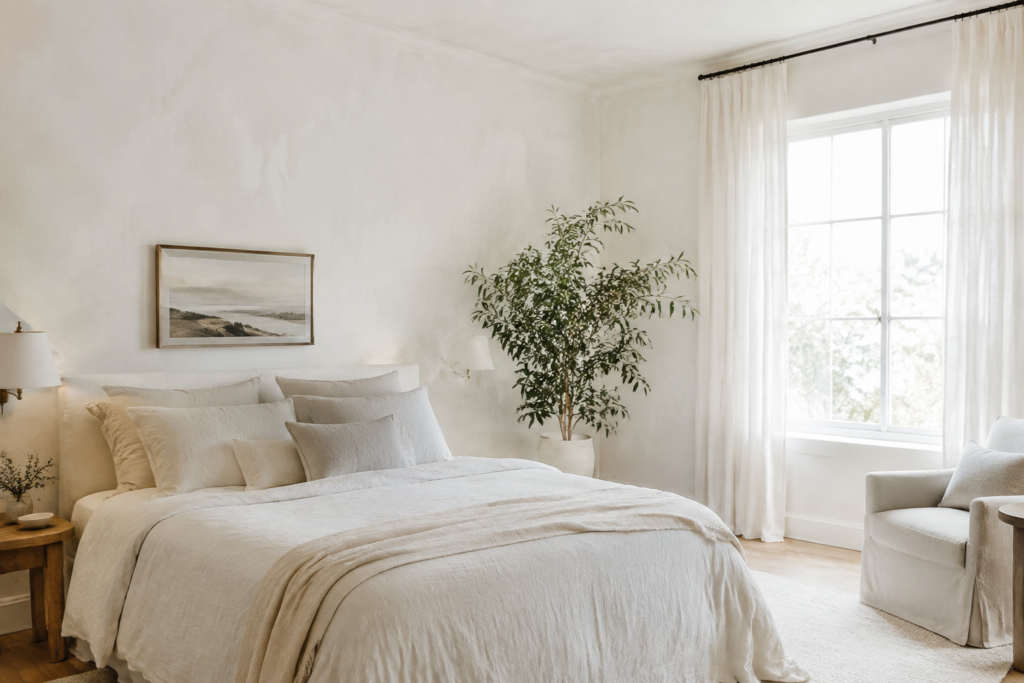
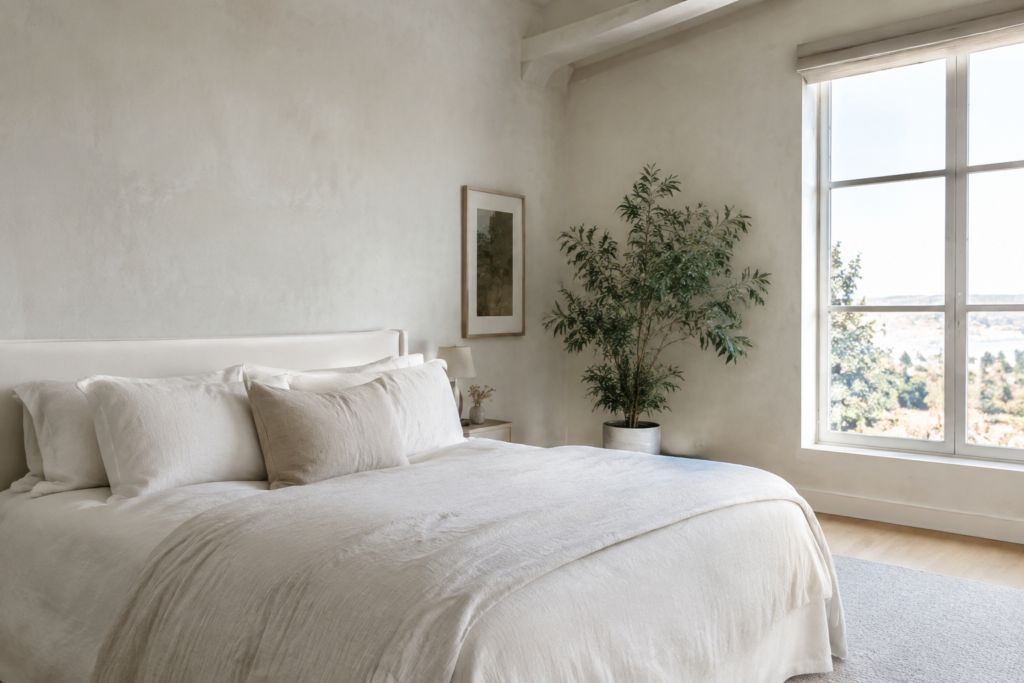
A quieter counterpoint to the moody look: soft, airy white paired with plants and natural materials. Archiproducts’ bedroom trend list opens with “Cloud Dancer: Pantone Color of the Year 2026,” followed by “Living with greenery” and a refuge for well-being. Cloud Dancer is a billowy, soft white that works with plaster, linen, oak and pale stone.
How to do it:
- Use warm whites. Cloud Dancer reads soft and slightly warm; avoid harsh bright white.
- Keep layers of white in different textures. Linen, cotton, wool, plaster and ceramic avoid a flat look.
- Add greenery. Trailing plants on shelves, a tall olive or fig tree in a corner, or dried botanical arrangements.
- Use natural wood. Light oak or ash bedside tables.
- Consider air quality. Plants need light, so pick low-light varieties such as pothos, snake plant or ZZ for darker corners.
Mistakes to avoid: Expecting an all-white room to feel warm without texture and warm light. Add wood, wool and warm bulbs.
Trend 11: Antique, Personal and Collected Pieces
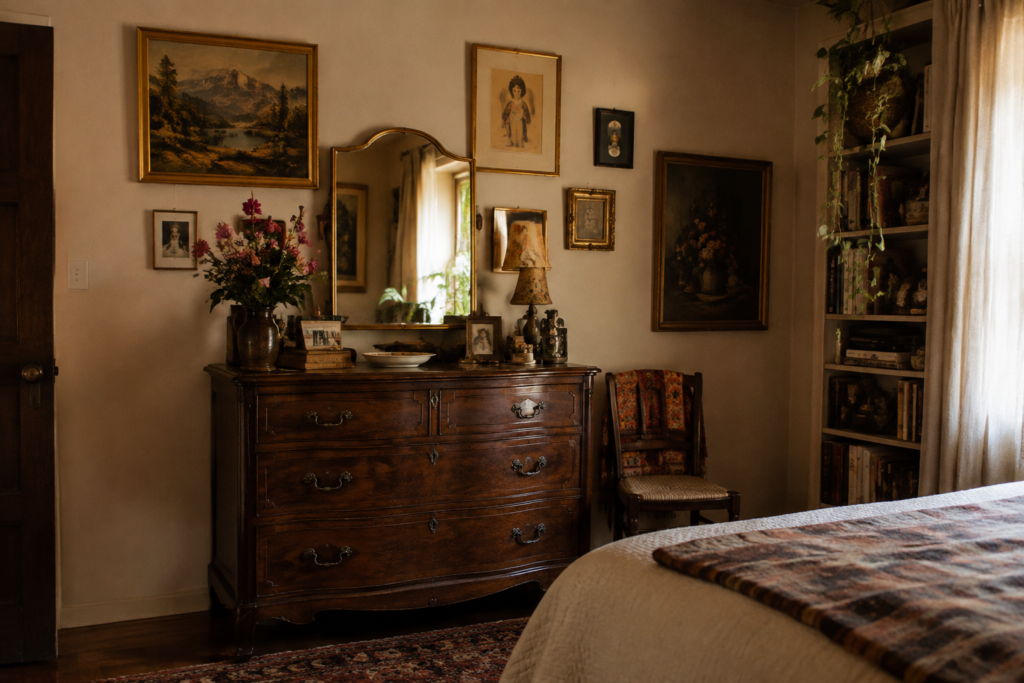
Bedrooms furnished with vintage furniture and meaningful objects rather than matching sets. Good Housekeeping highlights antique furniture and meaningful art. Martha Stewart says bedrooms are moving toward spaces that feel collected and individual, mixing “materials, eras, and moods,” including “layering in pieces from your travels.” The Spruce’s designers point to decorative dressers as a functional style choice.
How to do it:
- Replace the matching suite. Use a mix of nightstands, or two different but related ones.
- Find an antique dresser. It gives storage and a surface for display.
- Hang art that matters. A piece from a trip, a family portrait, or a textile.
- Add one unexpected item. A vintage stool, a painted trunk or an old mirror.
- Keep nightstand tops personal. A lamp, a book, one object.
Buying tips: Check drawers for smooth operation, look for solid wood and dovetail joints, and plan for refinishing or replacing hardware.
Mistakes to avoid: Overfilling. Pick a few pieces and give each room to breathe.
Trend 12: Layered, Warm-Dim Lighting
Multiple low-level light sources replacing a single harsh overhead. Veranda specifically highlights “warm-dim lighting” as a component of restful recovery zones. The Spruce advises designers’ tip to weave in layered lighting for a relaxed feel.
Layer plan:
Ambient: A ceiling fixture with a dimmer, or indirect cove lighting.
Task: Wall-mounted or bedside reading lights aimed at the pillows.
Accent: Picture lights, a lamp on the dresser, a glow in a cabinet.
Night: Motion-sensing floor-level lights for safe bathroom trips.
Technical tips:
Choose 2200K to 2700K bulbs; the lower end suits the evening.
Use CRI 90+ bulbs so fabrics look natural.
Put every circuit on a dimmer.
Keep blue-rich light (phones, cool LEDs) out of the last hour before bed.
Mount sconces around 56 to 60 inches from the floor for seated reading, or follow the manufacturer’s guide.
Mistakes to avoid: Lamps that are too small for the nightstand (the shade should be roughly two-thirds the height of the base), and wall sconces hung too high.
Trend 13: Bold Wallpaper and Tone-on-Tone Color
Pattern used fearlessly, often in one color family. Good Housekeeping highlights bold wallpapers. The Spruce quotes Taylor Johnson, who recommends tone-on-tone for anyone who wants color without overwhelm: for a client who loves blue, she layered different blues in the wallpaper, headboard fabric and throw, “adding brightness to the room without the end result being overwhelming.” Veranda’s cocoon example features an apple green stripe wallcovering with a paisley canopy and medallion-dotted linen curtains.
How to do it:
Pick a pattern with a clear color story. Botanical, stripes, paisley, trellis, toile.
Stay in one color family and vary the depth.
Pair with solid bedding so the walls stay the star.
Mix pattern scales. A large print on the walls, a small print on a cushion, a stripe on the drapes.
Consider wallpapering the ceiling for a jewel-box effect.
Mistakes to avoid: Wallpaper with heavy pattern on all four walls plus a busy bedspread. Choose the hero.
Trend 14: Wellness-Driven Bedrooms and Smart Comfort
Not every 2026 bedroom trend is about looks. Several are about how the room functions.
Wellness features. Veranda reports that Hart Howerton designers are adding “wellness-driven amenities” to suites, such as a petite sauna, a dedicated meditation corner or direct access to a private garden. For most homes, the realistic version is a quiet corner with a cushion, a diffuser and a blanket.
Smart comfort. The Spruce mentions smart fans; Good Housekeeping mentions smart blinds. Options include:
Automated blackout shades that open gently in the morning
Ceiling fans with quiet motors and remote or app control
Temperature-controlled bedding or mattress pads
Sunrise alarm lights
Air purifiers that disguise themselves as furniture
How to add without clutter: Choose devices with concealed cables, matte finishes and neutral tones. Keep screens out of arm’s reach of the bed.
Comfort-focused touches. The Spruce also stresses comfort-focused details such as a comfortable bench, a soft rug and a well-chosen throw.
Trend 15: Natural Materials and White Oak
Natural materials run through nearly every designer prediction. Hart Howerton’s Emma Feeney uses natural white oak on floors, walls and ceilings “to create spaces that feel calm and rich without tipping into ornament for its own sake.” Better Homes & Gardens’ designers add limewashed plaster, medium-toned woods, unlacquered metals and layered textiles to the list.
A natural-material shopping list:
Bed frame: solid oak, walnut, ash
Bedding: linen, cotton percale or sateen, wool
Walls: limewash, plaster, grasscloth
Floor: wide-plank oak, wool rug, jute
Lighting: paper, ceramic, alabaster, linen
Accessories: stone trays, clay vases, rattan
Why it works: Natural materials age gracefully, regulate temperature and feel good to touch, which supports the sensory, restorative aim of a bedroom.
What Is Going Out in 2026 Bedrooms
Fading
Replacing it
Stark white rooms with no texture
Cocooning layers and warm neutrals
Accent walls
Full color drenching
Matching bedroom furniture sets
Mixed, antique and personal pieces
Bare, high-gloss surfaces
Plaster, wood, wool, linen
Overhead-only lighting
Layered, dimmable, warm light
Blinds alone
Full-length layered drapery
Hard flooring with a tiny rug
Layered rugs and carpet
Over-styled “hotel photo” bedding
Relaxed, lived-in layers
Screens as the focal point
A reading nook or art
The Spruce has also published advice on bedroom furniture details designers now say look more dated than trendy; it is worth checking before you buy a new set.
Sleep-Smart Decorating Rules
A beautiful bedroom that disturbs your sleep is a failure. Keep these rules in mind.
Darkness: Use lined or blackout curtains and avoid LED indicator lights on electronics.
Temperature: Aim for a cool room, around 60 to 67 degrees Fahrenheit (15 to 19 Celsius) for most adults; use breathable bedding.
Noise: Soft furnishings, rugs and curtains absorb sound. Consider a white-noise machine in a noisy area.
Clutter: Visual clutter can raise mental load. Keep nightstands and dresser tops simple.
Scent: Choose calming scents such as lavender or cedar, and avoid overpowering candles near the bed.
Screens: Charge devices across the room, or use a drawer with a charging port.
Routine cues: A chair, a tray and a lamp can cue relaxation.
Bedding Guide for the 2026 Look
Bedding is the fastest way to change the room.
The layering formula:
Fitted sheet and flat sheet (linen or percale)
Duvet or quilt in a tonal color
A coverlet or folded blanket at the foot
Two sleeping pillows, two euro pillows, one or two decorative cushions, and one lumbar
A throw in a contrasting texture
Fabric guide:
Fabric
Feel
Best for
Linen
Relaxed, breathable, wrinkled
Hot sleepers, lived-in look
Percale
Crisp, cool
Warm climates
Sateen
Silky, warm
Luxurious feel
Velvet
Plush, rich
Burgundy and moody rooms
Quilted cotton
Textured, cozy
Cocooning
Wool or alpaca throws
Warm, tactile
Finishing layer
Color pairing ideas:
Burgundy walls with cream linen and a chocolate throw
Sage drenched room with oatmeal bedding and a mustard pillow
Clay walls with ivory sheets and a rust velvet cushion
Cloud Dancer white room with layered whites and a green throw
Styling tip: Relaxed beats perfect. Let the duvet fall naturally, and skip the overly symmetrical hotel staging.
Budget Guide
Budget
Best upgrades
Save on
Under $200
Paint a small color-drenched room or a ceiling; new bedding set; warm bulbs; a plug-in sconce
Furniture (use what you have)
$200 to $1,000
Ready-made drapery with lining, a layered rug, bedside lamps, a DIY upholstered headboard
Keep the bed frame, add a slipcover
$1,000 to $4,000
Upholstered headboard or bed, wallpaper, bespoke curtains, dresser, lighting
Antique and secondhand pieces
$4,000+
Built-in bed, textured ceiling, wall-to-wall carpet, custom joinery
Decorative accessories can be collected slowly
Where to splurge: Mattress and bedding (you use them every night), window treatments and lighting.
Where to save: Decorative objects, artwork (prints, vintage), and side tables.
Layout and Size Guide
Small Bedrooms
Use color drenching to blur edges.
Choose wall-mounted sconces instead of nightstand lamps to save space.
Opt for floating or slim nightstands.
Hang curtains high and wide to make the window feel larger.
Try a storage bed or built-in surround.
Medium Bedrooms
Add a bench at the foot of the bed and a statement headboard.
Create a corner with a chair and a lamp.
Layer a rug that extends at least 18 inches on each side of the bed.
Large Bedrooms and Suites
Create a true lounge zone with a sofa or two chairs.
Use rugs to define the sleep and sit zones separately.
Add wellness touches such as a meditation cushion and a tea station.
Scale up art and lighting so the room does not feel empty.
Rental Bedrooms
Use peel-and-stick wallpaper or a large fabric panel behind the bed.
Hang curtains on a ceiling-mounted track.
Layer rugs over existing flooring.
Switch out bulbs and add plug-in sconces.
Shared Rooms and Multipurpose Spaces
Hide a desk inside a cabinet or behind a screen.
Use curtain dividers to separate sleep from work.
Choose storage that closes so visual noise stays low at night.
Step-by-Step 2026 Bedroom Makeover
Decide your feeling. Cocooned, serene, dramatic, or collected? Write three words.
Choose the palette. One main color, two supporting tones, one accent.
Fix the bed position. The bed should be the focal point, ideally on the wall that is visible from the door, with space on both sides.
Paint or cover the walls. Drench the room or choose a wallpaper hero.
Install drapery. Hung high, lined and full.
Add the bed anchor. A sculptural headboard or built-in surround.
Layer the floor. Rug or carpet, at least two textures.
Build the lighting. Ambient, task, accent, all dimmable.
Dress the bed. Linen, texture, relaxed layers.
Add personal pieces. One antique, one piece of art, one plant.
Edit. Remove anything that does not help you sleep, relax or feel like yourself.
Live in it. Adjust after a week.
FAQ
What are the biggest bedroom trends in 2026? Cocooning, color drenching, deep burgundy and earthy palettes, drapery as decor, textured ceilings, built-in beds, layered rugs, statement headboards and suite-style lounge zones.
Are dark bedroom colors a good idea? Yes, if you like them. Dark, warm colors feel cozy and restful. Use layered warm lighting and keep some lighter elements to prevent heaviness.
Is an accent wall still in style? Designers say its time has passed. Color drench the whole room or wallpaper a full room instead.
What color is trending for bedrooms in 2026? Burgundy, cocoa brown, clay, sage, dusty plum and soft Cloud Dancer white.
How can I make my bedroom cozier? Lower the lighting, add texture, use fuller curtains, layer rugs and choose a tonal palette.
What is a cocoon bedroom? A bedroom designed to feel enclosed and safe through warm color, plush textiles, low light and tactile materials.
Are textured ceilings practical? Yes, and they can be done simply with paint, wallpaper or grasscloth. Wood slats or beams are more involved.
What should I avoid in a small bedroom? Oversized furniture, too many patterns and single harsh overhead lighting.
How much should I spend on bedding? Prioritize the mattress and sheets. A good-quality linen or percale set is a wise investment.
Can I follow these trends in a rental? Yes. Use removable wallpaper, curtains on a ceiling track, rugs, bedding and lighting.